- Research suggests procrastination is mostly about avoiding an unpleasant feeling, not about time management.
- Make the first step tiny and concrete: open the file, write the title, put on your shoes.
- Decide when and where you'll start. A set time removes the daily debate.
- Forgive yourself for last time. In one study, students who did procrastinated less on the next exam.
You know the task matters. You have the time. And yet you tidy your desk, check one message, then another. Procrastination is one of the most common struggles there is, and also one of the most misunderstood. This guide explains what's really going on, and gives you a handful of techniques that research suggests can help — starting with the smallest one.
Why we put things off
Pooling hundreds of studies, Piers Steel found that people procrastinate most on tasks that feel unpleasant and whose reward is far away. Impulsiveness and being easily distracted played a large role; perfectionism, often blamed, was only weakly linked.
Fuschia Sirois and Timothy Pychyl describe procrastination as a way of repairing your mood in the short term: the task makes you feel bored, anxious or unsure, and putting it off brings instant relief. The cost is paid later, by your future self. Seen this way, procrastination isn't a time problem. It's a feeling problem — which is why a better calendar rarely solves it.
Make the first step tiny
The unpleasant feeling is strongest just before you start. So make starting almost nothing. Not "write the report" but "open the document and write the title". Not "go for a run" but "put on my running shoes". Once you've started, carrying on is usually much easier than you feared — and if it isn't, you still did the first step.
- Name the very first physical action. If you can't picture yourself doing it, it's still too big.
- Give yourself permission to stop. Five minutes, then you can stop with a clear conscience. Often you won't.
- Leave a "next step" when you stop. A note saying where to resume makes tomorrow's start tiny too.
Decide when and where
"I'll do it later" invites a new debate every hour. A plan of the form "When X happens, I'll do Y" closes it in advance. A meta-analysis by Peter Gollwitzer and Paschal Sheeran, pooling 94 studies, found that people who made this kind of plan reached their goals noticeably more often than those who only intended to. "At 9 am, with my first coffee, I open the file" is a plan. "This morning" is a wish. For more on this, see our guide on setting intentions.
Add friction to distractions, remove it from the task
- Put the phone in another room for the first twenty minutes.
- Close every tab except the one you need.
- Prepare the task the night before: the file open, the notes on the desk, the gym bag by the door.
- Work where the task lives. The same desk, the same café table, the same time — the place starts to cue the work.
Work in short, protected blocks
Set a timer for 20 or 25 minutes and do only the task until it rings. Then take a real break. Short blocks make the task feel finite, which takes the edge off the unpleasant feeling. Two or three blocks a day, at the same times, move most projects forward faster than the occasional heroic all-nighter.
Forgive yourself for last time
It sounds soft, but it's one of the more surprising findings. In a study by Michael Wohl, Timothy Pychyl and Shannon Bennett, students who forgave themselves for procrastinating before a first exam procrastinated less before the next one. Beating yourself up keeps the task linked to a bad feeling — and the bad feeling is exactly what you'll want to avoid next time. Acknowledge it, let it go, start small.
Turn starting into a habit
For work you do often — writing, studying, admin, exercise — the strongest move is to stop deciding altogether. Give the task a fixed daily slot and a small minimum ("20 minutes on the thesis, after breakfast"), and check it off each day. After a while, the slot itself starts the work. See how to track habits for a simple way to do it.
When it's more than procrastination
This guide is about habits, not medical advice. Everyone puts things off sometimes. But if it affects almost every part of your life, or if it worries you, it can be worth talking to a doctor.
A worked example: one week
Monday. A report has been waiting for ten days. The plan: "At 9, with my coffee, I open the file and write the headings." Ten minutes of headings turn into forty minutes of writing.
Tuesday. A note from yesterday says "next: section 2, the figures". Starting takes thirty seconds.
Wednesday. A bad day; nothing done. No self-flagellation — just tomorrow's first step written down.
Thursday and Friday. Two 25-minute blocks each morning, phone in the kitchen. The report is sent on Friday afternoon.
Common mistakes
- Waiting to feel motivated. Motivation usually comes after starting, not before.
- A first step that's still a project. "Plan the report" is not a first step. "Write three headings" is.
- Huge, rare work sessions. Short daily blocks beat one heroic weekend.
- Harsh self-talk. Guilt makes the next start harder. Forgive, then start small.
- Fighting your phone with willpower. Put it in another room. Distance beats discipline.
How Yolmira helps
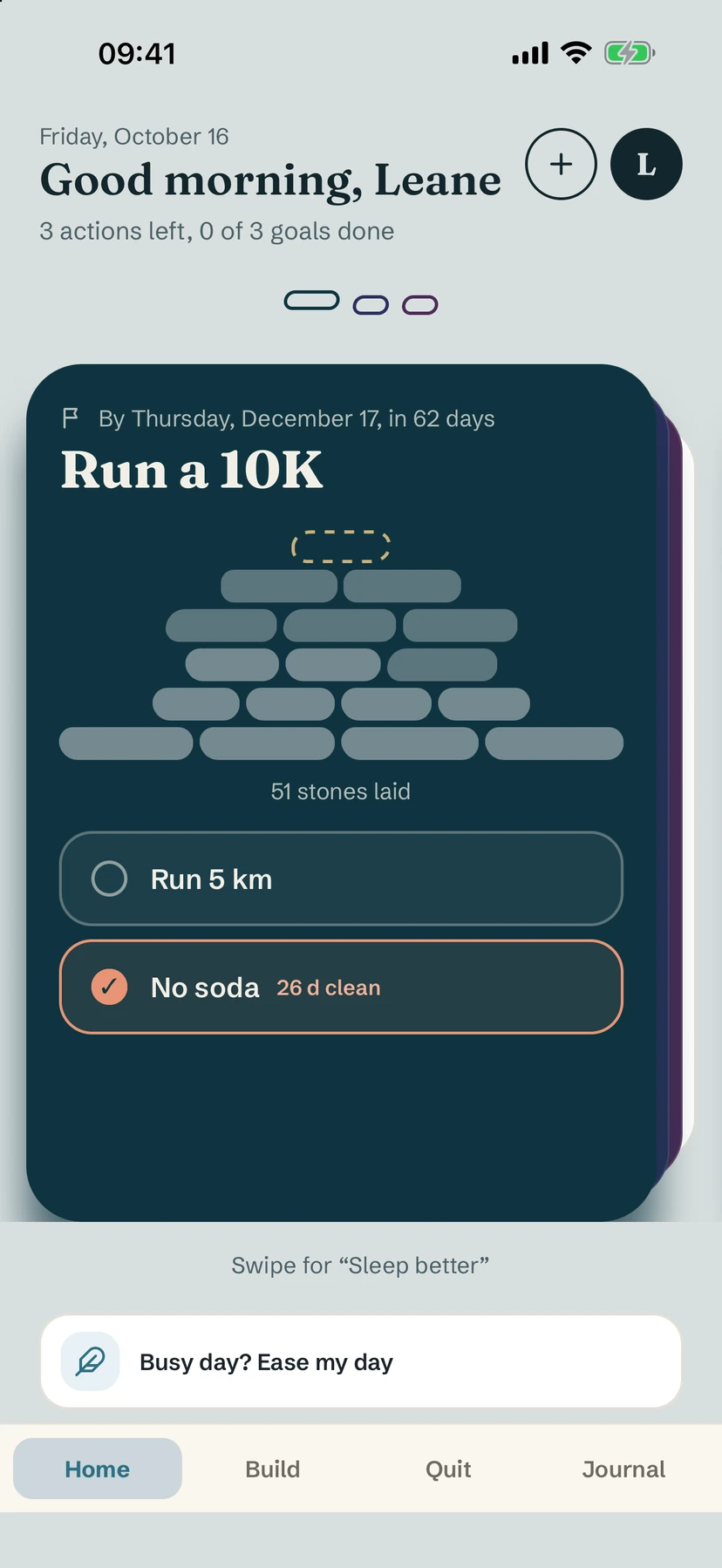
In Yolmira, turn the task you keep putting off into a daily habit with a small minimum — "20 minutes on the project" — linked to the goal it serves. Give it a reminder at the time you'll start (+ Add a time), and anchor it to something you already do: with an Anchor, Yolmira asks "You just did … And now?" right after your coffee or your commute.
In the evening, write tomorrow's first step under Tomorrow, I… in the Journal; it comes back on Home the next morning. Every day you show up lays a stone on the goal's cairn — and a missed day is just a missed day, never a reason to give up. Everything stays on your phone.
Questions people ask
Why do I procrastinate even when I want to do the task?
Research suggests procrastination is mostly a way of avoiding an unpleasant feeling — boredom, anxiety, uncertainty — in the moment. Putting the task off brings short-term relief, at the cost of your future self.
What is the fastest way to stop procrastinating?
Make the first step tiny and concrete — open the file, write the title — and decide exactly when you'll do it. Starting is the hardest part; carrying on is usually easier.
Does forgiving yourself really reduce procrastination?
In one study, students who forgave themselves for procrastinating before a first exam procrastinated less before the next one. Guilt keeps the task linked to a bad feeling, which makes avoiding it more tempting.
Is procrastination the same as laziness?
No. People who procrastinate often care a lot about the task. The problem is the unpleasant feeling around starting it, not a lack of effort or values.
How do I stop procrastinating on studying?
Give studying a fixed daily slot and a small minimum, put your phone in another room, work in 20 to 25-minute blocks, and leave a note saying where to resume next time.
Sources
- Steel, P. (2007). The nature of procrastination: A meta-analytic and theoretical review of quintessential self-regulatory failure. Psychological Bulletin, 133(1), 65–94.
- Sirois, F., & Pychyl, T. (2013). Procrastination and the priority of short-term mood regulation: Consequences for future self. Social and Personality Psychology Compass, 7(2), 115–127.
- Gollwitzer, P. M., & Sheeran, P. (2006). Implementation intentions and goal achievement: A meta-analysis of effects and processes. Advances in Experimental Social Psychology, 38, 69–119.
- Wohl, M. J. A., Pychyl, T. A., & Bennett, S. H. (2010). I forgive myself, now I can study: How self-forgiveness for procrastinating can reduce future procrastination. Personality and Individual Differences, 48(7), 803–808.