- Intentions turn into action only about half the time. The gap isn't a lack of sincerity; it's a lack of plan.
- A specific plan — when, where, what — is one of the best-studied ways to close that gap.
- Research suggests announcing who you'll become can backfire, while reporting what you did tends to help.
- Close the loop: write it tonight, read it in the morning, check it in the evening.
"Tomorrow I'll go for a run." "This year I'll read more." Everyone sets intentions, and everyone knows how often they quietly vanish. This guide is about the whole journey: how to phrase an intention so it has a chance, whether to announce it, and how to check it afterwards without turning your life into a report card.
Why intentions slip
The distance between meaning to do something and doing it has a name in psychology: the intention–behaviour gap. Reviewing the research, Paschal Sheeran and Thomas Webb describe how people with a sincere intention to act — to exercise, eat better, study — often don't follow through; across studies, it's close to half of them. They weren't lying. Their intention simply met a busy day, a tired evening or a forgotten moment.
So the problem is rarely the intention itself. It's what happens between saying it and the moment it's supposed to happen.
Make it specific: when, where, what
"I'll exercise more" can't be done; it can only be felt guilty about. "Tomorrow at 7, after coffee, I'll walk around the block" can. The most studied version of this is the implementation intention, a plan of the form "When situation X happens, I'll do Y". A meta-analysis by Peter Gollwitzer and Paschal Sheeran, pooling 94 studies, found that people who made this kind of plan reached their goals noticeably more often than people who only intended to.
- One intention at a time. One for tomorrow is plenty; five is a to-do list.
- Small enough to be sure. Ten pages, not a chapter. You can always do more.
- Tied to a moment. After coffee, on the way home, before opening the laptop.
- Phrased as an action. "Call the dentist", not "be more organised".
For goals that last months, see how to turn a goal into habits.
Should you announce it?
The usual advice is to tell everyone, so you'll feel committed. Research suggests it's more nuanced. In a series of studies by Gollwitzer and colleagues, people who stated an identity goal — becoming a good lawyer, say — and had someone take note of it then put in less effort than those who kept it to themselves. Saying it out loud seemed to give them part of the satisfaction in advance. These were small lab studies, and not every announcement backfires, but it's a useful warning.
On the other side, a meta-analysis by Benjamin Harkin and colleagues found that monitoring your progress helps you reach your goals, and that the effect was stronger when progress was written down or reported to someone. The difference is what you share: not who you'll be, but what you actually did.
- Share progress, not promises. "I walked four times this week" rather than "I'm becoming a runner".
- Choose one person, not an audience. A friend who'll ask "how did it go?" is worth more than a hundred likes.
- Agree on a check-in. A message every Sunday, a coffee every two weeks — something with a date.
- Keep some intentions private. It's perfectly fine to tell no one and simply keep a record for yourself.
Close the loop every day
An intention you never look at again is just a wish. A simple daily loop makes it something you can check:
- In the evening, write one intention for tomorrow. Specific and small.
- In the morning, read it. Reading it again at the start of the day puts it back in your head when it matters.
- The next evening, check it honestly. Done, partly, or not. Then write tomorrow's.
Over a week, this record tells you something useful: which intentions you keep, which ones you keep postponing, and which days are too full to promise anything. A short evening journal is the natural place for this.
When an intention keeps coming back, make it a habit
If you write "go for a walk" every other evening, it's no longer an intention: it's a habit waiting to be named. Turn it into one, with a cue and a minimum, and track it instead of re-promising it every day. Keep your evening intention for the one-offs: the call to make, the thing to prepare, the small kindness to do.
When you didn't keep it
You won't keep them all. When an intention slips, ask one question — what got in the way? — and adjust the next one: smaller, at a better moment, or with less on the same day. Don't copy the same promise unchanged night after night; that's how intentions start to feel like reproaches. And never double up to make up for a missed one.
A worked example: one week
Sunday evening. "Tomorrow, I… walk 20 minutes after lunch."
Monday. Read in the morning; done at 1 pm. In the evening: "Tomorrow, I… call Mum on the way home."
Tuesday. Forgotten — a late meeting. No guilt: "Wednesday, I… call Mum at 7, before dinner." Done.
Thursday. "Walk after lunch" again — the third time this week. It becomes a habit with its own check-off.
Sunday. A message to a friend: "Walked four times this week, called Mum, and I'm sleeping better." Facts, not promises.
Common mistakes
- Too vague. "Be healthier" can't be checked. Name the action and the moment.
- Too many. One intention per day is a plan; five is pressure.
- Announcing the identity instead of the action. Say what you'll do, and later what you did.
- Never checking. Without the next-day check, you can't learn what works.
- Repeating the same failed promise. If it slipped twice, change it.
How Yolmira helps
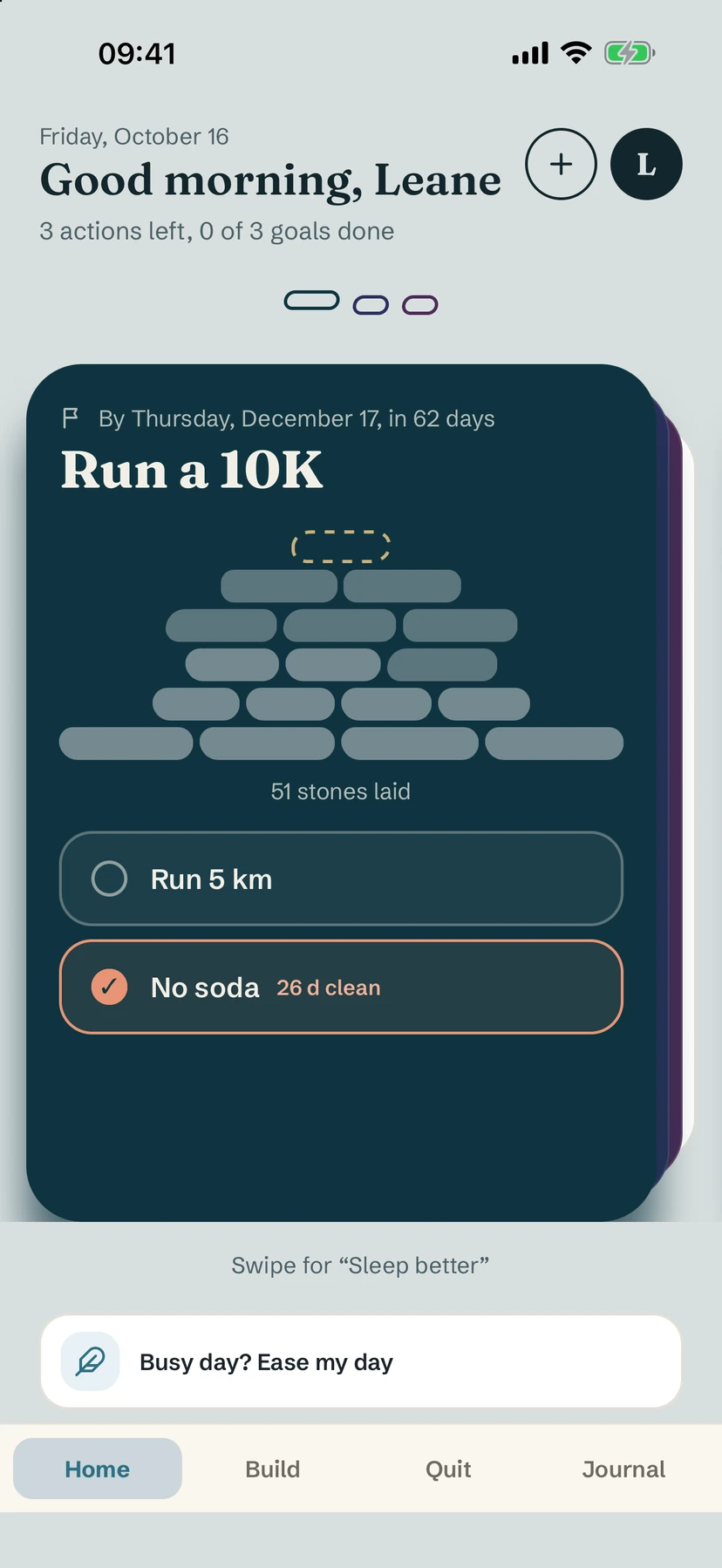
Yolmira closes the loop for you. In the Journal tab, write one intention under Tomorrow, I…. The next morning it comes back on Home, in your own words: "Yesterday, you told yourself:". In the evening, a line in your journal is enough to note how it went, and Earlier days keeps the whole record for your weekly look back.
When an intention keeps returning, add it as a habit and link it to a goal: each day you complete it adds a stone to the goal's cairn, so your progress is visible without being a score. Everything stays on your phone — whether you share your progress, and with whom, is up to you. The journal and intentions are free.
Questions people ask
What is the difference between an intention and a goal?
A goal is where you want to end up; an intention is one specific thing you'll do, usually soon. Good intentions are small steps towards a goal.
How do I set an intention I'll actually keep?
Make it specific — when, where and what — and small enough to be sure. Write it the evening before, read it in the morning and check it the next evening.
Should I tell people about my goals?
Research suggests sharing who you want to become can reduce effort, while reporting what you actually did tends to help. Share progress with one person rather than announcing plans to everyone.
What should I do when I don't keep an intention?
Ask what got in the way and adjust the next one: smaller, at a better moment, or on a lighter day. Don't repeat the same promise unchanged or try to double up.
Should I set intentions in the morning or the evening?
Writing it the evening before and reading it in the morning works well: you plan with a clear view of tomorrow, and you're reminded when the day starts.
Sources
- Sheeran, P., & Webb, T. L. (2016). The intention–behavior gap. Social and Personality Psychology Compass, 10(9), 503–518.
- Gollwitzer, P. M., & Sheeran, P. (2006). Implementation intentions and goal achievement: A meta-analysis of effects and processes. Advances in Experimental Social Psychology, 38, 69–119.
- Gollwitzer, P. M., Sheeran, P., Michalski, V., & Seifert, A. E. (2009). When intentions go public: Does social reality widen the intention-behavior gap? Psychological Science, 20(5), 612–618.
- Harkin, B., Webb, T. L., Chang, B. P. I., Prestwich, A., Conner, M., Kellar, I., Benn, Y., & Sheeran, P. (2016). Does monitoring goal progress promote goal attainment? A meta-analysis of the experimental evidence. Psychological Bulletin, 142(2), 198–229.