- In a well-known study on habit formation, missing one day did not materially slow the process down.
- The real risk is psychological: after a broken streak, people tend to disengage — research on streaks shows the effect is smaller when they can repair it.
- A simple rule helps: never miss twice. One miss is an accident; two in a row is the start of a new pattern.
- Plan lighter days in advance for illness, travel or hard weeks, so they don't count as failures.
You were on day 23. Then a late night, a sick child, a flight, a bad day — and the counter is back to zero. For many people, this is the moment a habit dies. Not because one day mattered, but because the zero did.
What one missed day really does
Very little. In Lally and colleagues' study of how habits form in everyday life, participants who missed a single opportunity to do their new behaviour saw no meaningful effect on how automatic it became. The curve kept rising. Habit strength is built from many repetitions in the same context; one gap is a blip in that record, not an erasure.
Repeated misses are different — they weaken the link between the cue and the action. Which is why what you do after a miss matters far more than the miss itself.
The trouble with streaks
Streaks work because we hate to lose them. That's also their trap. Researchers Jackie Silverman and Alixandra Barasch (2023) found that when a log shows a broken streak, people engage less with the activity afterwards — even when their actual behaviour was the same as people whose streak looked intact. Keeping the streak had quietly become the goal.
Two details from that research are worth knowing. The drop was larger when people blamed themselves for the break, and smaller when they could repair the streak. In other words, how a tracker treats a missed day can decide whether you keep going.
The "all or nothing" trap
Relapse researchers have a name for the spiral: the abstinence violation effect. One slip feels like proof that you've failed, so you might as well stop trying. Dieters call it "what the hell" eating — one biscuit, so why not the packet.
It's worth naming because it's predictable. If you know it's coming, you can catch the thought — "the streak is gone, so…" — and answer it: the habit isn't gone. Only the counter is.
Never miss twice
The simplest rule for consistency is also the kindest: you're allowed to miss a day; you don't miss two in a row. One miss is life happening. Two is the beginning of a new routine — the one where you don't do it.
To make the second day easy, shrink the habit. If the plan was a 5 km run, the comeback is a ten-minute walk in your running shoes. If it was a chapter, it's one page. The point of the comeback day isn't the workout, it's re-connecting the cue and the action.
Plan the hard days before they happen
Some misses aren't failures at all — they're predictable. Illness, travel, a deadline week, a new baby. Decide in advance what your habit looks like on those days:
- A light version that keeps the chain: stretching instead of the gym, one line in the journal instead of a page.
- Planned rest that doesn't count against you: a week off a running plan while you're ill is part of training, not a break in it.
- A restart date written down, so "after the holidays" has an actual day attached.
How Yolmira handles a missed day
Yolmira was designed around this research. If you break a streak of three days or more by missing a single day, you can repair it — "forgive yesterday" — once a month for free, and as often as you need with Yolmira Pro. A gentle evening reminder can nudge you when a streak is about to break, with no guilt in the wording.
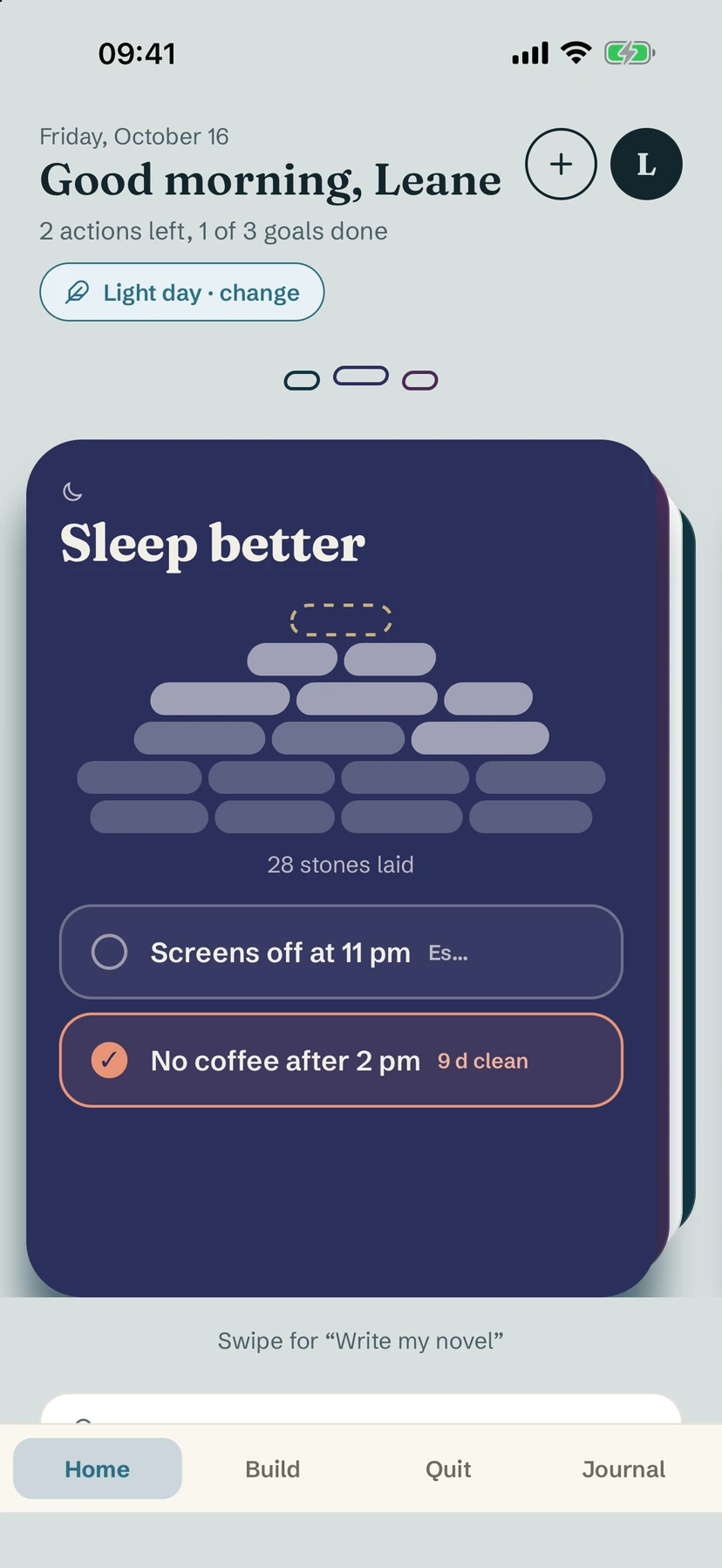
When life gets heavy, you can mark a light day or take leave for up to 30 days: neither breaks a streak, removes a stone or counts as missed. Forgot to tick something? Open the habit and fix any past day. And on each goal's cairn, a stone once laid stays laid — progress you made stays made.
Questions people ask
Does missing one day ruin a habit?
No. Research on habit formation found that missing a single opportunity did not materially affect how automatic a behaviour became. What matters is getting back to it the next day.
What does 'never miss twice' mean?
It's a practical rule: missing one day is fine, but avoid missing two in a row, because two misses start to form a new pattern. Doing a tiny version of the habit on the second day is enough.
Should I restart my streak from zero?
Your habit isn't back at zero even if your counter is. If your tracker lets you repair a streak after a single miss, use it — research suggests the ability to repair a streak reduces the motivation drop that follows a break.
How do I keep a habit when I'm sick or travelling?
Decide in advance on a lighter version or a planned rest period, and pick a restart date. Planned rest is part of the routine, not a failure of it.
Sources
- Lally, P., van Jaarsveld, C. H. M., Potts, H. W. W., & Wardle, J. (2010). How are habits formed: Modelling habit formation in the real world. European Journal of Social Psychology, 40(6), 998–1009.
- Silverman, J., & Barasch, A. (2023). On or off track: How (broken) streaks affect consumer decisions. Journal of Consumer Research, 49(6), 1095–1117.
- Marlatt, G. A., & Gordon, J. R. (Eds.). (1985). Relapse prevention: Maintenance strategies in the treatment of addictive behaviors. Guilford Press.