- There is no single number. In the best-known study, the median was 66 days, but people ranged from 18 to 254 days.
- A 2024 review of the research found the same picture: a median of about two months (59–66 days), with individual times from 4 to 335 days.
- Simple actions become automatic faster than demanding ones. Doing it in the same place, at the same moment speeds things up.
- Missing a single day did not measurably derail habit formation. Missing many did.
Search for how long a habit takes and you'll meet the same answer everywhere: 21 days. It's tidy, it fits in a month, and it's wrong. Not slightly wrong — wrong in a way that quietly makes people quit. If you expect a new routine to feel effortless after three weeks and it doesn't, the natural conclusion is that something is wrong with you. Usually nothing is. You're just early.
Where the 21-day idea comes from
The number traces back to the 1960 self-help book Psycho-Cybernetics by Maxwell Maltz, a plastic surgeon. He observed that his patients seemed to take a minimum of about 21 days to get used to a change, like a new face in the mirror. Over decades of retelling, "a minimum of about" dropped away and "getting used to something" became "forming a habit". Nobody had measured habit formation at all.
What the research actually measured
The study most people cite today comes from University College London. Phillippa Lally and colleagues (2010) asked about a hundred volunteers to pick one healthy behaviour — drinking a glass of water with lunch, eating a piece of fruit, a short run before dinner — and do it every day in the same situation for twelve weeks. Each day, participants rated how automatic it felt: did they do it without thinking, without having to remember?
Automaticity rose quickly at first, then levelled off, like a curve flattening towards a ceiling. The researchers measured how long it took each person to get close to their own ceiling. The median was 66 days. The range ran from 18 days to 254 days — and for some people the curve hadn't flattened by the end of the study.
Fourteen years later, a systematic review by Singh and colleagues (2024) pulled together the studies on health habits published since. Same shape: a median of roughly 59 to 66 days, an average closer to 106–154 days because a few slow habits pull it up, and individual times anywhere from 4 to 335 days.
The honest answer isn't "21 days" or "66 days". It's "probably a couple of months, possibly much longer — and that's normal."
What decides how long it takes for you
The range is wide because habits aren't all the same. A few things consistently make a difference.
How demanding the behaviour is
In Lally's study, simple behaviours like drinking a glass of water tended to become automatic sooner than demanding ones like doing fifty sit-ups after morning coffee. The more effort and decisions a behaviour involves, the longer it takes to run on its own. That's an argument for starting smaller than you think you need to.
A stable cue
Habits are associations between a situation and an action. The more consistent the situation — after you brush your teeth, when you sit down at your desk, right after lunch — the faster the link forms. The 2024 review also found that behaviours done in the morning tended to stick more readily, probably because mornings are more predictable than evenings.
Repetition, not intensity
Frequency matters more than heroics. A daily ten-minute walk will become automatic sooner than a weekly two-hour hike. If you want something to feel easy, do a small version of it often.
Whether you enjoy it at all
People keep doing what feels rewarding now, not what pays off in a year. Pick a version of the habit you can actually like — the podcast you only listen to while walking, the good tea you only make when you sit down to read.
Missing a day doesn't reset the clock
One of the most useful findings from the UCL study gets the least attention: missing one opportunity did not materially affect the habit-forming process. The curve kept rising. What does hurt is the story we tell ourselves after a slip — "I've blown it" — that turns one missed day into a missed week. We wrote a whole guide on that: missed a day? Why a broken streak doesn't ruin a habit.
How to plan with a range instead of a deadline
- Commit to a season, not forever. Thirty, sixty-six or ninety days is long enough to see the curve bend and short enough to feel finite. At the end, decide consciously whether to keep going.
- Expect the middle to feel flat. The early weeks bring quick gains in automaticity; the later ones are slower. That's the curve, not failure.
- Judge by effort, not by the calendar. The sign a habit is forming is that it takes less remembering and less negotiating. When you catch yourself doing it without deciding to, you're close.
- Attach it to something you already do. "After I pour my coffee, I'll stretch for two minutes." A clear if-then plan is one of the best-supported tools in the research — more in how to turn a goal into habits.
- Make the first version almost too easy. One page, one push-up, one sentence in a journal. You can grow a habit that exists; you can't grow one you keep skipping.
How Yolmira is built around this
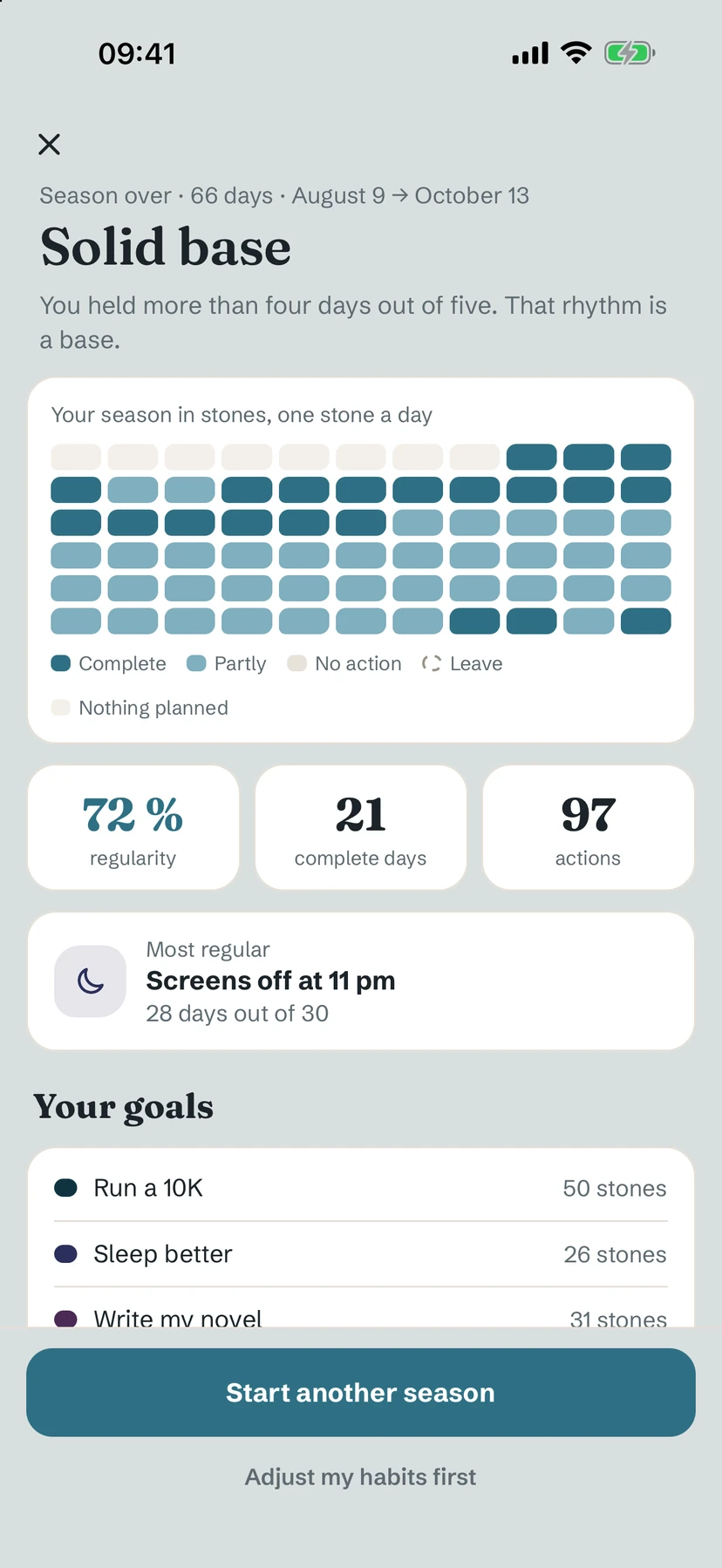
We built Yolmira so the app tells you the truth about time instead of a number that sounds good in an ad. You can commit to a season and get a calm recap when it ends — the days you kept, laid out as stones, and an invitation to start again or adjust. Each goal grows a cairn: one stone for every day you did what that goal needed. A stone, once laid, is never taken back, even after a bad day.
Because missing one day isn't the end, Yolmira gives you a way to repair a streak after a single miss, and light days or leave for the weeks when life is heavier — they never count as failures. And everything stays on your phone: no account, no tracking.
Questions people ask
Is it true that it takes 21 days to form a habit?
No. The 21-day figure comes from a 1960 self-help book describing how long people took to get used to a change, not from research on habits. Studies that measured habit formation found a median of about two months, with a very wide range.
What is the 66-day rule?
It refers to the median time in Lally et al.'s 2010 study, where participants took 66 days on average (median) to reach near-maximum automaticity for a new daily behaviour. Individual times ranged from 18 to 254 days, so 66 is a midpoint, not a promise.
Does missing one day break a habit?
In the same study, missing a single opportunity did not materially affect habit formation. Repeated misses do slow it down, and the bigger risk after one slip is giving up altogether.
Which habits form fastest?
Simple behaviours tied to a stable cue and repeated often tend to become automatic fastest — for example drinking a glass of water after brushing your teeth. Demanding behaviours like vigorous exercise usually take longer.
Sources
- Lally, P., van Jaarsveld, C. H. M., Potts, H. W. W., & Wardle, J. (2010). How are habits formed: Modelling habit formation in the real world. European Journal of Social Psychology, 40(6), 998–1009.
- Singh, B., et al. (2024). Time to form a habit: A systematic review and meta-analysis of health behaviour habit formation and its determinants. Healthcare, 12(23), 2488.
- Wood, W., & Rünger, D. (2016). Psychology of habit. Annual Review of Psychology, 67, 289–314.
- Gollwitzer, P. M., & Sheeran, P. (2006). Implementation intentions and goal achievement: A meta-analysis of effects and processes. Advances in Experimental Social Psychology, 38, 69–119.