- A large share of what we do each day is habitual — triggered by context, not decided. That's why willpower alone wears out.
- The strongest lever is the cue: change the place, time or object that sets the habit off, and add friction to the old path.
- Cravings behave like a wave: they rise, peak and pass. Waiting ten minutes and breathing slowly is often enough to let one go by.
- Plan a replacement with an if-then sentence: If I feel the urge to scroll in bed, then I put the phone on the charger in the hall.
- A slip is information, not a verdict. Counting urges you got through tells you more than counting failures.
Most advice about bad habits treats them as a test of character: try harder, want it more. It rarely works, because a habit isn't something you decide to do. It's something that happens when a familiar situation shows up. Understanding that one point changes almost everything about how to quit.
Why bad habits run on autopilot
In diary studies, Wendy Wood and colleagues found that a large share of everyday behaviour — around four in ten actions — was repeated almost daily in the same context, often while people were thinking about something else. Over time, the situation itself starts the action: the sofa calls for the phone, the 3 p.m. slump calls for something sweet, the drink in your hand calls for a cigarette.
That's why habits feel so stubborn. Your intention may have changed, but the cue hasn't, and research on habits suggests that once a behaviour is strongly habitual, the context predicts what you'll do better than your intentions do.
Step 1: Find the cue and change the scene
For a week, don't try to stop. Just notice. When the urge shows up, what time is it? Where are you? Who's around? What were you doing a minute before? You're looking for the pattern — and there almost always is one.
Then change what you can:
- Move the object. Phone charging in the hall, not by the bed. Biscuits on the top shelf, or not in the house.
- Add friction. Log out of the app. Delete the saved card. Make the old habit three steps longer.
- Use change to your advantage. A new job, a move, a holiday all scramble old cues. It's a good moment to quit something.
Step 2: Let the craving rise and fall
You won't remove every cue. Sometimes the urge arrives anyway — and here the most useful idea is that a craving is not an order. It's a wave. It builds, peaks and falls, usually faster than it feels in the moment.
Psychologists call this urge surfing: instead of fighting the craving or giving in, you watch it. Where do you feel it in your body? Is it getting stronger or weaker? In a study by Bowen and Marlatt (2009), smokers who were taught this kind of mindful observation smoked fewer cigarettes in the following week than those who weren't.
In practice:
- Name it. "This is a craving. It will pass."
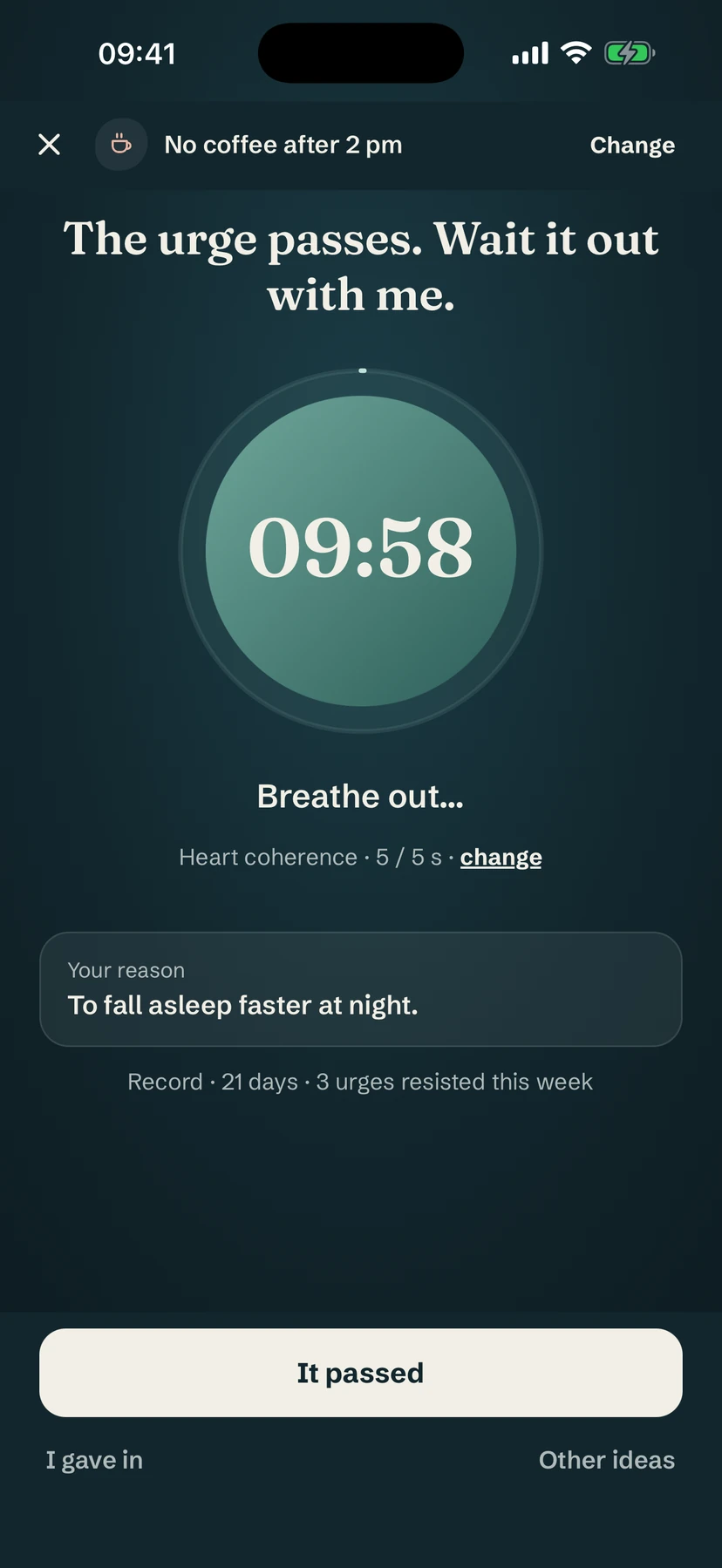
- Set a timer for ten minutes. You're not saying never — you're saying not yet.
- Breathe slowly. Longer out-breaths than in-breaths help your body settle.
- Remind yourself why. In your own words, written down when you were calm.
- Then decide. Often, by then, there's nothing left to decide.
Step 3: Replace, don't just remove
Habits usually do a job — they calm you down, fill a gap, give you a break. Remove one without a substitute and the gap pulls it back. Decide in advance what you'll do instead, and write it as an if-then plan:
If I want to open Instagram while I'm bored, then I'll read one page of the book on my desk.
If I crave something sweet at 4 p.m., then I'll make tea and go outside for five minutes.
If I reach for my phone in bed, then I'll put it on the charger in the hall.
If-then planning — what researchers call implementation intentions — is among the best-supported tools in behaviour change. A meta-analysis of 94 tests found a medium-to-large effect on reaching goals, and the approach works for resisting temptations as well as starting new behaviours.
Step 4: Treat a slip as data
Relapse researchers describe what they call the abstinence violation effect: after one slip, people tell themselves the whole effort is ruined, and then give up entirely. One cigarette becomes the pack; one episode becomes the evening.
The antidote is boring and effective. Write down what happened — time, place, feeling — and look for the cue you missed. Then carry on tomorrow. A day you slipped is still a day you learned when your hardest moment is. Over weeks, that's the information that tells you where to put friction next.
Count what you got through
Most quit trackers only count days since your last slip, so the only thing they can show you after a bad day is a zero. It's more encouraging — and more informative — to also count the urges you got through, and when they tend to come back. Patterns like "mostly between 2 and 6 p.m." or "Sunday evenings" are exactly what you need to plan around.
How Yolmira helps you quit
Yolmira has a separate Quit tab for habits you want to stop. A day counts as clean unless you say otherwise, and freedom milestones mark the way. When a craving hits, the craving screen opens a calm, dark ten-minute timer with a few breathing rhythms and your own reason to stop. You leave by saying it passed — which counts as an urge resisted — or that you gave in, which is a simple, honest log, never a lecture. The craving tool is free, always.
My cravings shows how many urges you've got through and when they tend to come back, by time of day and day of week, so you can plan the friction where it's needed. And because it's all on your phone with no account, nobody else sees any of it.
Questions people ask
What is the fastest way to break a bad habit?
Change the cue. Removing or moving the thing that triggers the habit — the phone by the bed, the snacks on the counter — works faster and more reliably than relying on willpower in the moment.
How long does a craving last?
Cravings rise, peak and fade like a wave, often within minutes. Delaying for ten minutes and breathing slowly is usually enough to let one pass, though strong cravings tied to a dependency can return in waves.
What is urge surfing?
A technique from relapse-prevention research: instead of fighting a craving or giving in, you observe it — where you feel it, how it changes — until it subsides. It was found to reduce smoking in a 2009 study of college students.
What should I do after a relapse?
Treat it as information rather than proof of failure. Note when and where it happened and what you felt, then continue the next day. The bigger risk is the all-or-nothing thinking that turns one slip into giving up.
Sources
- Wood, W., Quinn, J. M., & Kashy, D. A. (2002). Habits in everyday life: Thought, emotion, and action. Journal of Personality and Social Psychology, 83(6), 1281–1297.
- Wood, W., & Neal, D. T. (2007). A new look at habits and the habit–goal interface. Psychological Review, 114(4), 843–863.
- Bowen, S., & Marlatt, G. A. (2009). Surfing the urge: Brief mindfulness-based intervention for college student smokers. Psychology of Addictive Behaviors, 23(4), 666–671.
- Gollwitzer, P. M., & Sheeran, P. (2006). Implementation intentions and goal achievement: A meta-analysis of effects and processes. Advances in Experimental Social Psychology, 38, 69–119.
- Marlatt, G. A., & Gordon, J. R. (Eds.). (1985). Relapse prevention: Maintenance strategies in the treatment of addictive behaviors. Guilford Press.
This guide is general information, not medical advice. If you are trying to stop drinking, smoking, gambling or using a substance, a doctor, a pharmacist or a support service can offer help that an app cannot — including treatment that makes cravings easier to get through.