- Researchers call it bedtime procrastination: going to bed later than you intended, with nothing really stopping you. It's common, and it's linked to sleeping too little.
- The phone in your hand is the cue. The most reliable fix is distance: charge it outside the bedroom.
- Plan what you'll do instead with an if-then sentence: If I get into bed, then I read two pages of a paper book.
- When the urge to check "just one more thing" hits, it usually passes in minutes if you don't feed it.
It starts innocently. You get into bed, pick up your phone to set an alarm, and an hour later you're watching a stranger renovate a kitchen. You're tired, you know you'll regret it in the morning, and you still can't put it down. If that sounds familiar, you're in good company — and the reason has little to do with discipline.
Bedtime procrastination is a real thing
In 2014, Floor Kroese and colleagues gave it a name: bedtime procrastination, going to bed later than intended without any external reason to stay up. In their study, people who procrastinated more in general also put off going to bed more often — and those who did reported getting insufficient sleep more often. The point isn't that they didn't want to sleep. It's that bedtime is the end of a long day, when self-control is at its lowest and the phone is the easiest thing in the room.
That's why "I'll just be stronger tonight" rarely works. Tonight you'll be just as tired as last night.
The phone is the cue
Habits are triggered by context. Research on habits suggests that once a behaviour is strongly linked to a place and a moment, the situation itself starts it — your intentions come second. Bed plus phone plus tiredness is about as strong a cue as there is.
So the most effective move is also the least heroic: change the situation, not your resolve.
- Charge the phone outside the bedroom. In the hall, the kitchen, anywhere you'd have to get up to reach it.
- Buy a cheap alarm clock. "I need it for the alarm" is the most common reason the phone ends up on the pillow.
- Add friction if it must stay close. Log out of the app you scroll most, move it off your home screen, or switch the screen to greyscale in the evening.
Decide what the last ten minutes look like
Taking the phone away leaves a gap, and gaps get filled by the old habit. Give the last ten minutes of your day a job, written as an if-then plan — the format with some of the strongest evidence in behaviour change:
If I brush my teeth, then I put my phone on the charger in the hall.
If I get into bed, then I read two pages of a paper book.
If I can't sleep after twenty minutes, then I get up and sit somewhere dim — without the phone.
Two pages is deliberately small. The aim isn't a reading habit (though you might get one — see how to read every day). It's to give your hands and your mind something to do that ends.
When the urge to check hits
Some nights you'll be lying there and feel the pull: a message you might have missed, a score to check. That pull is a craving, and cravings behave like waves — they rise, peak and fade, usually faster than it feels. Notice it, name it ("that's the urge to check"), take a few slow breaths and let it pass. Our guide on riding out a craving goes into the technique.
If you slip, keep the evidence, drop the guilt
You will scroll in bed again. That's not failure; it's information. Was it a stressful day? Did the phone come into the bedroom "just for the alarm"? Write it down and adjust the plan. One bad night doesn't undo the habit — what matters is getting back to it the next night.
A worked example: one week, three changes
Here is what a realistic first week can look like for someone who scrolls for an hour most nights.
Monday to Wednesday — just observe. No rules yet. Each morning, note roughly when you put the phone down and what you were doing on it. Most people discover one or two apps account for nearly all of it, and that the scrolling starts within a minute of getting into bed.
Thursday — move the charger. The cable goes to the hall, the old alarm clock comes out of a drawer. The first night feels strange; you'll probably reach for the bedside table out of reflex. That reflex is the habit, showing itself.
Friday — give the hands a job. A paper book or a notebook goes on the pillow in the morning, so it's the first thing you see at night.
Weekend — plan the exception. Weekends have a different rhythm. Decide in advance: if you want to watch something in bed on Saturday, set a timer for one episode, then the phone goes back to the hall. A planned exception is still a plan.
By the end of the week the goal isn't perfection. It's that the phone has a new place to sleep, and you have one thing to do instead.
Common mistakes
- Relying on screen-time limits alone. A limit that you can dismiss with one tap is a speed bump, not a wall. It helps more when combined with distance.
- Swapping one screen for another. Moving from the phone to a tablet or a laptop in bed changes the device, not the habit.
- Making the replacement too ambitious. "Read for thirty minutes" fails on tired nights. Two pages works on all of them.
- Treating a late night as a reset. One evening of scrolling doesn't wipe out the progress you've made. The next night is just the next night.
If I want to check one last thing, then I write it on the notepad by the bed and look tomorrow.
If I wake up at night and want the phone, then I count ten slow breaths first.
If it's 10:30 p.m., then the phone goes on the charger — whatever I'm in the middle of.
How Yolmira helps
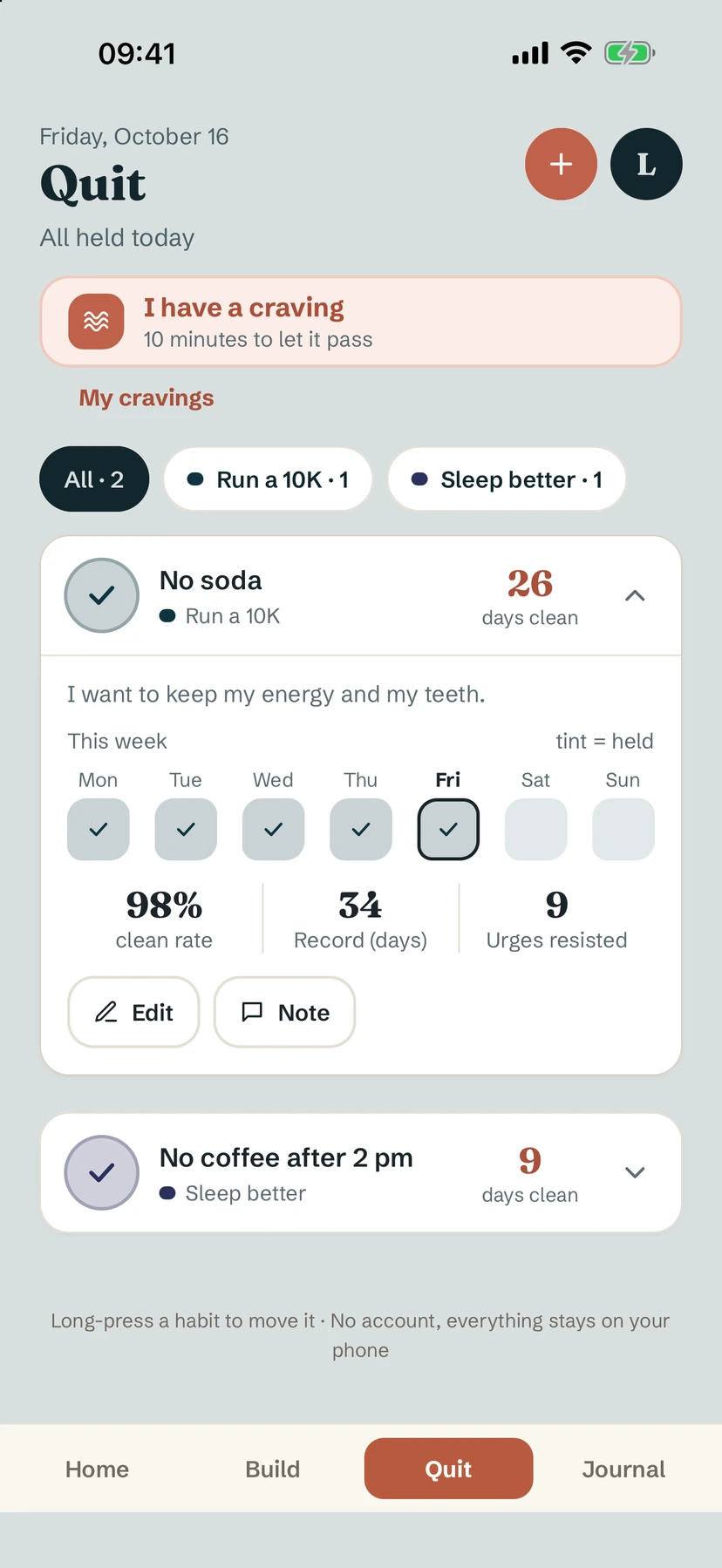
In Yolmira, you can add "No phone in bed" as a habit to quit. Each night without it counts as a clean day, and freedom milestones mark the way. When the urge hits, the craving screen opens a dark, calm ten-minute timer with slow breathing and your own reason — "I want to wake up rested", say. Saying it passed counts as an urge resisted; saying you gave in is a simple, honest note, never a lecture.
You can link the habit to a goal like "Sleep better", next to a habit to build such as "Read two pages in bed", and see in My cravings when the urge tends to come back. Everything stays on your phone, with no account — which is, admittedly, the one time we're happy for you to pick it up.
Questions people ask
Why can't I stop scrolling in bed?
Because bed, tiredness and a phone in your hand form a strong cue, and self-control is at its lowest at the end of the day. Researchers call putting off sleep without a reason bedtime procrastination.
What is the best way to stop using my phone in bed?
Charge it outside the bedroom and use a separate alarm clock. Changing where the phone is works more reliably than relying on willpower when you're tired.
What should I do instead of scrolling before sleep?
Give the last ten minutes a small, finite job: two pages of a paper book, a few lines in a journal, some slow breathing. Write it as an if-then plan.
What is bedtime procrastination?
Going to bed later than you intended, without any external reason for staying up. A 2014 study found it was linked to getting insufficient sleep.
Sources
- Kroese, F. M., De Ridder, D. T. D., Evers, C., & Adriaanse, M. A. (2014). Bedtime procrastination: Introducing a new area of procrastination. Frontiers in Psychology, 5, 611.
- Wood, W., & Neal, D. T. (2007). A new look at habits and the habit–goal interface. Psychological Review, 114(4), 843–863.
- Gollwitzer, P. M., & Sheeran, P. (2006). Implementation intentions and goal achievement: A meta-analysis of effects and processes. Advances in Experimental Social Psychology, 38, 69–119.