- Research suggests habits done in the morning tend to stick more readily, probably because mornings are more predictable.
- Anchor each step to something you already do: "after I pour my coffee, I stretch for two minutes".
- Keep it short — two or three steps — and start with a version so small you can't skip it.
- Leave the phone for later. Checking it first hands your morning to someone else's priorities.
Morning routines have a reputation problem. Search for one and you'll find people waking at 5 a.m. for cold showers, journaling, meditation, a workout and a green smoothie — all before breakfast. It's inspiring for a day and exhausting by Thursday. The routines that actually last look much smaller.
Why mornings work
There's a good reason to build habits in the morning. A 2024 review of research on habit formation found that behaviours done in the morning tended to become habits more readily than those done later in the day. The likely explanation is simple: mornings are predictable. You wake up, go to the bathroom, make coffee — roughly the same steps, in the same order, in the same place. That's exactly the kind of stable cue habits need.
Evenings, by contrast, are messy: late meetings, dinners out, tiredness. Anything that depends on them gets skipped.
Anchor each step to something you already do
Don't build your routine on the clock ("at 7:15, I meditate"). Build it on actions that already happen every morning. This is an if-then plan — one of the best-supported techniques in behaviour change — and it means the existing routine does the remembering for you.
After I turn off my alarm, I drink a glass of water.
After I pour my coffee, I stretch for two minutes.
After I sit down at the table, I write one line about today.
That's it. Three steps, all attached to things you were going to do anyway. Our guide on habit stacking has more examples.
Start smaller than feels useful
Two minutes of stretching won't change your life. But a routine you do every day for two months will — and the first goal is simply to make the morning automatic. In Lally's study, simpler behaviours became automatic sooner than demanding ones. Start with the version you can do half-asleep, then grow it once it runs on its own.
A good test: could you do it on your worst morning — after a bad night, with a sick child, running late? If not, make it smaller.
Leave the phone for later
The fastest way to lose a morning is to read messages before you're out of bed. Suddenly you're thinking about someone else's problem, and the glass of water never happens. Try keeping the phone out of the bedroom (see how to stop scrolling in bed) and only checking it after your last morning step.
Plan for the hard mornings
There will be mornings when nothing goes to plan. Decide now what the minimum version looks like: the glass of water and nothing else. Doing the minimum keeps the chain going, and research suggests missing a single day barely affects habit formation anyway. What matters is that tomorrow, the routine is still there.
Give it time
A new morning routine won't feel natural after a week, or after 21 days. Research puts the median at around two months, with a wide range — see how long it takes to form a habit. Expect the middle weeks to feel flat. That's the curve, not failure.
A worked example: from nothing to ten minutes
Here is how a morning routine can grow over two months, starting from almost nothing.
Weeks 1–2. One step: after turning off the alarm, drink the glass of water left on the bedside table the night before. That's the whole routine. It feels too small to count — which is the point.
Weeks 3–4. Add a second step: after pouring the coffee, stretch for two minutes in the kitchen while it cools.
Weeks 5–8. Add a third: after sitting down with the coffee, write one line about the day ahead. Some days it becomes a paragraph; most days it's one line.
After two months, there's a ten-minute routine that runs mostly on its own, built from three steps that each felt trivial. Compare that with starting on day one with an hour of everything — and abandoning it by the second week.
Common mistakes
- Waking up much earlier to fit it in. Cutting sleep to make room for a routine usually backfires within a week. Fit the routine into the mornings you already have.
- Copying someone else's routine. A routine built for a person without children, or with a later start, won't fit your mornings. Start from your own existing steps.
- Adding everything at once. Each new step is a new habit to form. Add one, wait until it runs on its own, then add the next.
- Making it depend on the evening. If your morning plan needs you in bed by 10 p.m., one late night breaks it. Have a minimum version that works whatever time you slept.
If I'm running late, then I only drink the glass of water and skip the rest.
If I'm travelling, then I do the stretch in the hotel room before breakfast.
If I wake up before the alarm, then I start the routine rather than reaching for the phone.
Weekends and holidays
Routines anchored to a workday morning often wobble at the weekend: you sleep later, the coffee happens at a different time, the house is louder. That's fine. Keep the anchors, not the clock. If your routine is "after the coffee, stretch", it still works at 9:30 on a Saturday. On holiday, pick the one step that travels best — usually the glass of water or a few minutes of stretching — and let the rest wait until you're home. Coming back to the full routine is much easier when one piece of it never stopped.
How Yolmira helps
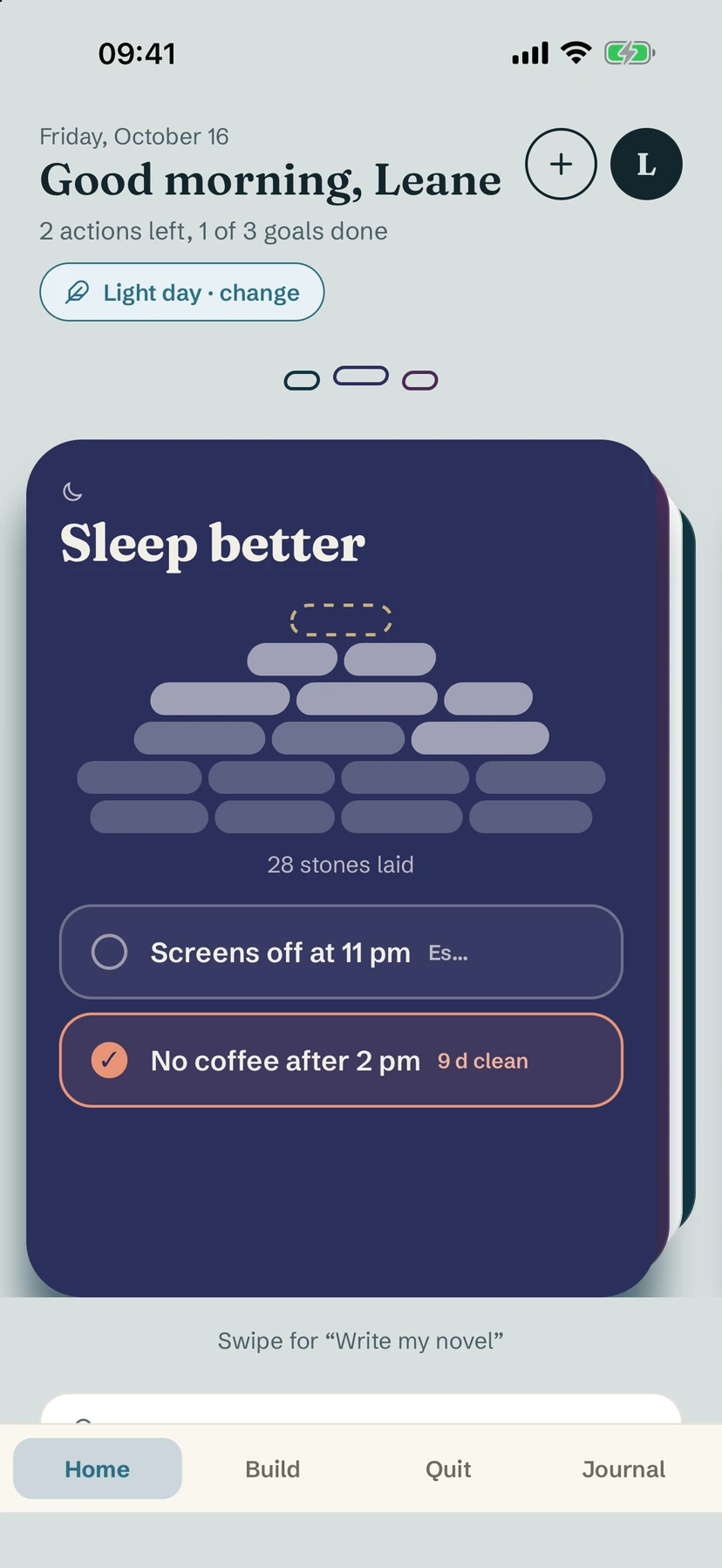
In Yolmira you can add each step as a habit to build, set it for every day or only weekdays, and anchor it to another with habit stacking — "after my coffee, I stretch for two minutes". Tick the first one off and the next one is offered. Link them to a goal like "Calmer mornings", and every complete day lays a stone on its cairn.
On heavy days, mark a light day: it never breaks a streak or counts as missed. Commit to a season of 30, 66 or 90 days if a deadline helps, and get a kind recap at the end. And everything stays on your phone — so checking it in the morning only takes a second.
Questions people ask
How long should a morning routine be?
Short enough to do on your worst morning. Two or three small steps, anchored to things you already do, are more likely to last than an hour-long routine.
Are habits easier to build in the morning?
Research suggests so. A 2024 review found that behaviours done in the morning tended to become habits more readily, probably because mornings are more predictable.
How do I stick to a morning routine?
Attach each step to an existing action (after I pour my coffee, I stretch), start with a tiny version, keep the phone for later and decide in advance what you'll do on hard mornings.
Should I check my phone first thing in the morning?
It's easier to keep a morning routine if you don't. Checking messages first pulls your attention elsewhere before your own routine has happened.
Sources
- Singh, B., et al. (2024). Time to form a habit: A systematic review and meta-analysis of health behaviour habit formation and its determinants. Healthcare, 12(23), 2488.
- Lally, P., van Jaarsveld, C. H. M., Potts, H. W. W., & Wardle, J. (2010). How are habits formed: Modelling habit formation in the real world. European Journal of Social Psychology, 40(6), 998–1009.
- Gollwitzer, P. M., & Sheeran, P. (2006). Implementation intentions and goal achievement: A meta-analysis of effects and processes. Advances in Experimental Social Psychology, 38, 69–119.