- Intending to do something is not enough: people act on their intentions only about half the time. The gap is in the how and when.
- Translate each goal into one to three habits — things you can do on a given day, not outcomes you hope for.
- Write each habit as an if-then plan: When it's 7 a.m. on Monday, Wednesday and Friday, I run 5 km. This is one of the best-supported techniques in psychology.
- Measure the days you did what the goal needed, not just the distance left. Progress you can see keeps you going.
Most goals fail quietly. Not with a dramatic decision to give up, but with a slow drift: a busy week, a bad night, a Monday that becomes next Monday. The goal is still there — you still want to run the race, save the money, write the book — but nothing in your day connects to it.
The fix isn't more motivation. It's turning the goal into something you do.
The gap between wanting and doing
Psychologists call it the intention–behaviour gap. Across many studies, a large share of people who sincerely intend to act — exercise, eat better, study — don't follow through; reviews put it at close to half. They weren't lying about their intentions. They just hadn't decided when, where and how, so the moment never arrived.
That's the hidden flaw in most goals: they describe an outcome ("run a 10K", "save €1,000") but not a single action you could take this evening.
Turn each goal into one to three habits
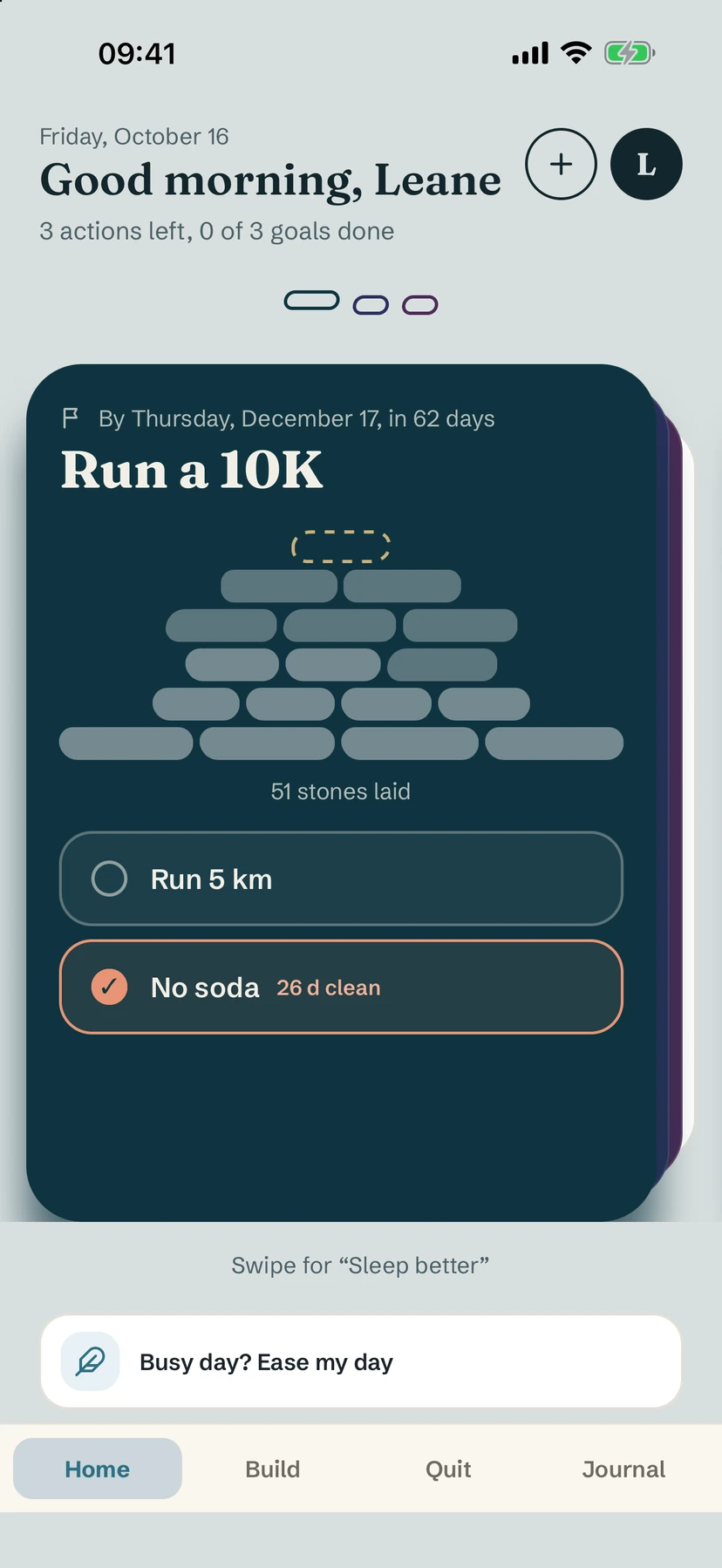
Ask a simple question: what would someone who reaches this goal be doing on an ordinary Tuesday? The answers are your habits.
Build: run 5 km three times a week. Quit: no soda (you want better sleep and energy). That's it — two habits, one goal.
Build: move €5 to savings every weekday. Quit: no food delivery after 9 p.m. One habit that adds, one that stops the leak.
Notice two things. First, a goal can need a habit to stop as much as one to start; building and quitting belong together. Second, keep it to one to three habits. More than that, and the plan collapses on the first difficult week.
Make each habit an if-then plan
Now give each habit a moment. The format that works best is an implementation intention: When situation X arises, I will do Y.
- "When I close my laptop at 6 p.m. on Mondays, Wednesdays and Fridays, I put on my running shoes."
- "When my salary arrives, I move €100 to savings before anything else."
- "After I pour my morning coffee, I write for ten minutes."
It sounds too simple to matter, but it's one of the most replicated results in behaviour science. A meta-analysis of 94 studies found a medium-to-large effect on goal attainment, and a 2024 meta-analysis of 642 tests confirmed the effect across many kinds of goals — strongest when the plan really is phrased as "if… then…", when people are motivated, and when they've mentally rehearsed it.
Anchoring a new habit on one you already have — after X, I do Y — is the same idea, sometimes called habit stacking. Your existing routine becomes the reminder.
Choose a good moment to start
Researchers studying the fresh start effect found that people are more likely to begin pursuing goals right after a temporal landmark — a new week, a new month, a birthday, the start of term. If you're struggling to begin, borrow one: start on Monday, or on the first of the month, and tell yourself that's when the new chapter begins.
Make progress visible — and forgiving
Long goals have a motivation problem: the finish line is far, and the distance left barely moves. What keeps people going is seeing that they're on the way. So track the days you did what the goal needed, not just the remaining kilometres or euros.
Make that record forgiving. A tracker that turns red the moment you miss a day teaches you to stop looking. Progress you've made should stay made — more on that in why a broken streak doesn't ruin a habit.
Review once a week, adjust once a season
Once a week, look back: which habit held, which one didn't, and why? Once a season — every month or three — ask the bigger question: is this still the right goal, and are these still the right habits? Changing a plan isn't failing it. Sticking to a plan that doesn't fit your life is how goals die.
How Yolmira turns goals into habits
In Yolmira, everything starts with a goal. Each goal is a card on your home screen with its own colour, an optional deadline, your reason for it, and milestones along the way. You link one or more habits to it — to build or to quit — and tick them off right from the card.
Every day you do what the goal needs, a stone is laid on its cairn. Stones are never taken back, even after a difficult day, so the cairn only ever grows. A gentle weekly recap shows how the week went, and you can anchor a new habit on one you already have. Up to three goals are free; Yolmira Pro, a one-time purchase, makes them unlimited.
Questions people ask
How many habits should I track to reach a goal?
One to three per goal is enough for most people. Fewer habits done consistently beat a long list that falls apart in the first hard week.
What is an implementation intention?
An if-then plan that links a specific situation to a specific action, such as 'When I finish lunch, I walk for ten minutes'. Meta-analyses of hundreds of studies have found it reliably improves follow-through.
What is the difference between a goal and a habit?
A goal is an outcome you want, like running a 10K. A habit is a behaviour you repeat in a given situation, like running after work on certain days. Goals give direction; habits do the work.
When is the best time to start a new goal?
Any time works, but people find it easier right after a 'fresh start' landmark — a Monday, the first of the month, a birthday. If you're stuck, pick the next one and commit to it.
Sources
- Sheeran, P., & Webb, T. L. (2016). The intention–behavior gap. Social and Personality Psychology Compass, 10(9), 503–518.
- Gollwitzer, P. M., & Sheeran, P. (2006). Implementation intentions and goal achievement: A meta-analysis of effects and processes. Advances in Experimental Social Psychology, 38, 69–119.
- Sheeran, P., et al. (2024). The when and how of planning: Meta-analysis of the scope and components of implementation intentions in 642 tests. European Review of Social Psychology.
- Dai, H., Milkman, K. L., & Riis, J. (2014). The fresh start effect: Temporal landmarks motivate aspirational behavior. Management Science, 60(10), 2563–2582.