- Making a resolution helps: in one study, 46% of resolvers were still succeeding after six months, against 4% of people who wanted to change but didn't resolve.
- Phrase it as something to do, not something to avoid. In a large 2020 experiment, approach goals succeeded more often (58.9% vs 47.1%).
- Turn each resolution into one to three habits with a moment attached.
- Expect a dip in the first weeks and plan for it — the fresh-start energy of January runs out for everyone.
Every January, articles announce that New Year's resolutions don't work. The research says something more interesting: resolutions do work — better than wanting to change without resolving at all. What fails is the typical way people set them, and the lack of a plan for the moment the January energy runs out.
Do New Year's resolutions work?
More than their reputation suggests. Norcross, Mrykalo and Blagys (2002) followed people who made New Year's resolutions and people who had similar goals but didn't make a resolution. Six months later, 46% of resolvers were continuously successful, compared with 4% of non-resolvers. Plenty of resolvers slipped along the way — but deciding, on a specific day, that something would change made a real difference.
That's the fresh start effect at work: temporal landmarks like a new year make people more likely to start pursuing their goals. January 1st is the biggest landmark of all.
Phrase it as something to do
How you word a resolution matters. In a large experiment by Oscarsson and colleagues (2020) with more than a thousand participants, people with approach-oriented goals ("start running", "eat more vegetables") were more likely to consider themselves successful a year later than people with avoidance-oriented goals ("stop eating sweets"): 58.9% against 47.1%.
So when a resolution is about stopping something, give it a positive twin: not just "stop scrolling at night" but "read before bed"; not just "no more takeaway" but "cook three dinners a week". You can still track the thing you're quitting — the positive action gives you something to do when the old habit calls.
Turn each resolution into one to three habits
"Get fit", "save money", "be calmer" are directions, not plans. For each resolution, ask what someone who achieves it would be doing on an ordinary Tuesday. Those are your habits. Keep it to one to three per resolution, and give each one a moment: after dinner on weekdays, I walk for fifteen minutes.
We go through this step by step in how to turn a goal into daily habits. If-then plans like these are among the best-supported techniques in psychology.
Pick fewer resolutions
Five resolutions means ten to fifteen new habits in the same month — while work restarts after the holidays and the evenings are dark. Choose one, two at most. You can add another in spring, once the first is running on its own.
Plan for the February dip
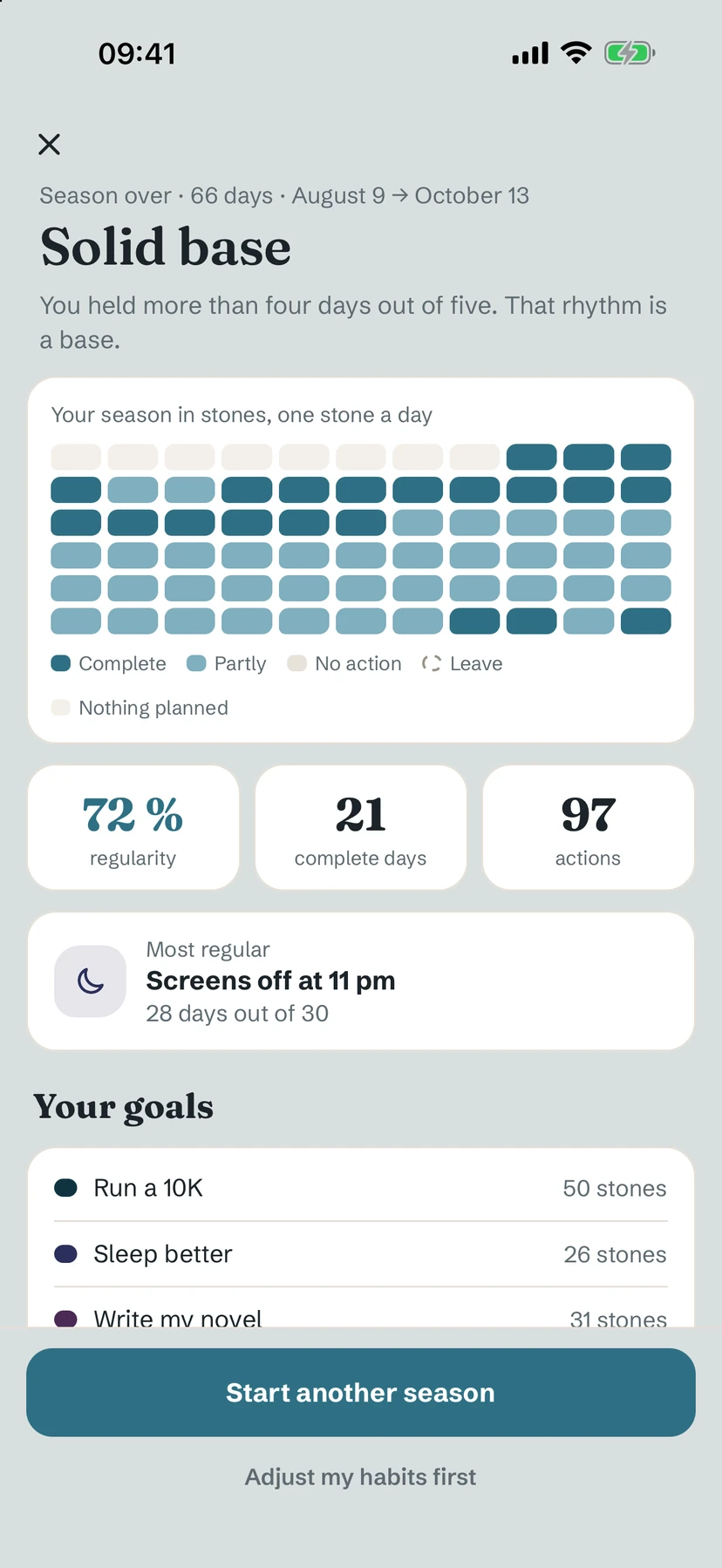
The excitement of January is real, and it fades for everyone. Plan for it now, while you're motivated:
- Decide your minimum version. On the worst day, what's the smallest thing that still counts? Ten minutes, one page, one euro.
- Commit to a season, not forever. Thirty, sixty-six or ninety days is long enough to see results and short enough to stay concrete. At the end, review and decide.
- Decide what happens after a slip. Never miss twice. One missed day is normal; it doesn't ruin the habit.
- Put a review in the calendar. A short check-in at the start of February: what's working, what needs to shrink?
You don't have to wait for January
The fresh start effect isn't only about New Year. A Monday, the first of the month, a birthday or the start of term all work as landmarks. If you're reading this in November, you can start the habit now and arrive at January with a head start — or use the time to plan, and start on the 1st with everything ready.
A worked example: "get healthier" becomes a plan
"Get healthier this year" is a direction. Here's how it can become something you can do on January 2nd:
- The goal, in approach form: "Have more energy by spring."
- Habit 1 (build): After dinner on weekdays, I walk for fifteen minutes.
- Habit 2 (build): When I make lunch, I add one portion of vegetables.
- Habit 3 (quit, with a positive twin): no phone in bed — when I get into bed, I read one page instead.
- The minimum: five minutes of walking, one vegetable, one paragraph.
- The season: 90 days, with a review on the first Sunday of February.
Common mistakes
- Resolutions about outcomes only. "Lose weight" or "be richer" give you nothing to do on a Tuesday evening.
- All-or-nothing rules. "Never again" turns the first slip into the end of the resolution.
- Starting everything on the same day. If you have two resolutions, consider staggering their start by a few weeks.
- Keeping score in your head. Without a visible record, a good fortnight and a bad one feel the same by February.
On a bad day in February
You will have one — usually a cold, busy week when the novelty has gone. That's when the minimum version earns its place: If I don't feel like walking tonight, I walk to the end of the street and back. And if a day slips completely, the only rule is not to let it become two. A resolution isn't broken by one bad day; it's broken by deciding that one bad day means it's over.
How to choose which resolution to keep
If you have a long list, choosing is half the work. Three questions help narrow it down:
- Does it matter to you, or to someone else's idea of you? Resolutions borrowed from social media rarely survive February.
- Can you name the first small action? If you can't describe what you'd do on January 2nd, the resolution needs more work before it starts.
- Would it make the others easier? Better sleep, for example, tends to make exercise, focus and eating well easier too. Start with the one that unlocks the rest.
Write down the ones you don't pick. They're not abandoned — they're scheduled for spring.
How Yolmira helps
In Yolmira, a resolution becomes a goal: a card with your reason for it, an optional deadline and milestones. Link one to three habits to it — to build or to quit — and every day you do what the goal needs, a stone is laid on its cairn. Stones are never taken back, so a bad week in February doesn't erase January.
Commit to a season of 30, 66 or 90 days and get a calm recap at the end. A gentle weekly recap on Sundays shows how the week went, and if a streak breaks after a single miss, you can repair it. Up to three goals are free; Yolmira Pro, a one-time purchase, makes them unlimited.
Questions people ask
Do New Year's resolutions actually work?
Better than their reputation. In a 2002 study, 46% of people who made a New Year's resolution were still succeeding six months later, compared with 4% of people with similar goals who didn't make a resolution.
Why do most resolutions fail by February?
The motivation of the new year fades, and many resolutions are too vague or too ambitious to survive a busy week. Turning a resolution into small, specific habits with a fixed moment, and planning for the dip in advance, helps them last.
How should I phrase a New Year's resolution?
As something to do rather than something to avoid. A large 2020 experiment found approach-oriented resolutions were more successful than avoidance-oriented ones.
How many resolutions should I make?
One or two. Each resolution usually needs one to three new habits, and starting many habits at once makes it harder to keep any of them.
Sources
- Norcross, J. C., Mrykalo, M. S., & Blagys, M. D. (2002). Auld lang syne: Success predictors, change processes, and self-reported outcomes of New Year's resolvers and nonresolvers. Journal of Clinical Psychology.
- Oscarsson, M., Carlbring, P., Andersson, G., & Rozental, A. (2020). A large-scale experiment on New Year's resolutions: Approach-oriented goals are more successful than avoidance-oriented goals. PLOS ONE, 15(12), e0234097.
- Dai, H., Milkman, K. L., & Riis, J. (2014). The fresh start effect: Temporal landmarks motivate aspirational behavior. Management Science, 60(10), 2563–2582.
- Gollwitzer, P. M., & Sheeran, P. (2006). Implementation intentions and goal achievement: A meta-analysis of effects and processes. Advances in Experimental Social Psychology, 38, 69–119.