- Habit stacking links a new habit to one you already do: after X, I do Y.
- It's a form of if-then planning, one of the best-supported techniques in behaviour research.
- The best anchors happen every day, at a stable moment, and end cleanly — finishing coffee, closing the laptop, brushing your teeth.
- Keep the new habit small and the link specific. One anchor, one new habit.
Remembering to do a new habit is half the battle. Alarms get dismissed, sticky notes become invisible within a week. But you already have dozens of routines that run on their own: you brush your teeth, make coffee, lock the door, plug in your phone. Each one is a reliable cue. Habit stacking simply borrows them.
What habit stacking is
Habit stacking means attaching a new habit to an existing one with a single sentence: After I [current habit], I will [new habit]. The current habit becomes the trigger. You don't need to remember a time — you need to notice something you were going to do anyway.
Why it works
Habit stacking is a form of what psychologists call implementation intentions: if-then plans that link a situation to an action. They are among the most studied tools in behaviour change. A meta-analysis of 94 studies found a medium-to-large effect on reaching goals, and a 2024 meta-analysis of 642 tests found the effect strongest when the plan is really phrased as "if… then…".
It also fits what we know about habits themselves. Research reviews describe habits as actions triggered by context. An existing routine is a ready-made, stable context — exactly what a new habit needs to grow.
What makes a good anchor
- It happens every day (or on every day you want the new habit).
- It has a clear end. "After I finish my coffee" works better than "while I'm having breakfast".
- It's in the right place. Stretching fits after getting out of bed; flossing fits after brushing.
- It matches the effort. Don't attach a workout to a moment when you're already rushing out the door.
And keep the new habit small. "After I pour my coffee, I write one sentence in my journal" will happen. "After I pour my coffee, I write for an hour" won't.
Examples: morning
- After I turn off my alarm, I drink a glass of water.
- After I get out of bed, I open the curtains and stretch for one minute.
- After I start the coffee machine, I take my vitamins.
- After I pour my coffee, I write one line about how I feel.
- After I brush my teeth, I floss one tooth (and usually all of them).
- After I get dressed, I make my bed.
- After I sit down on the train, I read one page.
Examples: during the day
- After I sit down at my desk, I write the one task that matters today.
- After I finish a meeting, I stand up and walk for two minutes.
- After I eat lunch, I go outside for ten minutes.
- After I refill my water bottle, I take three slow breaths.
- After I close my laptop, I put my running shoes on.
- After I park the car, I sit for one minute before going in.
Examples: evening and bedtime
- After I take my coat off, I put my phone on the charger in the hall.
- After dinner, I walk around the block.
- After I load the dishwasher, I tidy one surface for five minutes.
- After I set out tomorrow's clothes, I check tomorrow's calendar.
- After I brush my teeth at night, I write tomorrow's intention.
- After I get into bed, I read one page.
- After I turn off the light, I think of one good thing from today.
Examples: for habits you're quitting
Stacking works for stopping things too, by attaching a replacement to the moment the old habit usually starts:
- After I feel the urge to check my phone, I put it face down and take one breath.
- After I finish a meal, I brush my teeth instead of reaching for dessert.
- After I add something to a shopping basket, I close the tab and wait 48 hours.
- After I sit on the sofa in the evening, I make a herbal tea before anything else.
- After I feel stressed at work, I walk to the window instead of the vending machine.
For more on quitting, see how to break a bad habit by riding out the craving.
How to build your own anchor in three steps
- List what you already do every day, in order, from waking up to going to bed. Most people find twenty or thirty reliable routines: alarm, shower, coffee, commute, lunch, coming home, dinner, teeth, bed.
- Pick the moment where the new habit fits — by place, by energy level, by the time it takes. A two-minute habit fits almost anywhere; a twenty-minute one needs a moment with room around it.
- Write the sentence and say it once out loud. The 2024 meta-analysis found that mentally rehearsing the plan strengthened its effect. Picture yourself finishing the anchor and starting the new habit.
Common mistakes
- Vague anchors. "In the morning" or "when I have a moment" aren't cues. "After I switch off the kettle" is.
- Anchors that don't happen every day. If you only go to the gym twice a week, it's a poor anchor for a daily habit.
- Stacking too much at once. A chain of five new habits after breakfast collapses the first rushed morning. Add one link at a time.
- A new habit that's too big for the slot. Ten minutes of meditation doesn't fit between parking the car and walking into the office.
On a bad day
When the anchor happens but the energy isn't there, do the smallest version of the new habit: one stretch, one line, one breath. If the anchor itself didn't happen — you skipped coffee, you didn't go to the office — let the habit go for that day without guilt and pick it up at the next anchor. The chain is only as reliable as its first link, which is why choosing a daily anchor matters so much.
How Yolmira helps
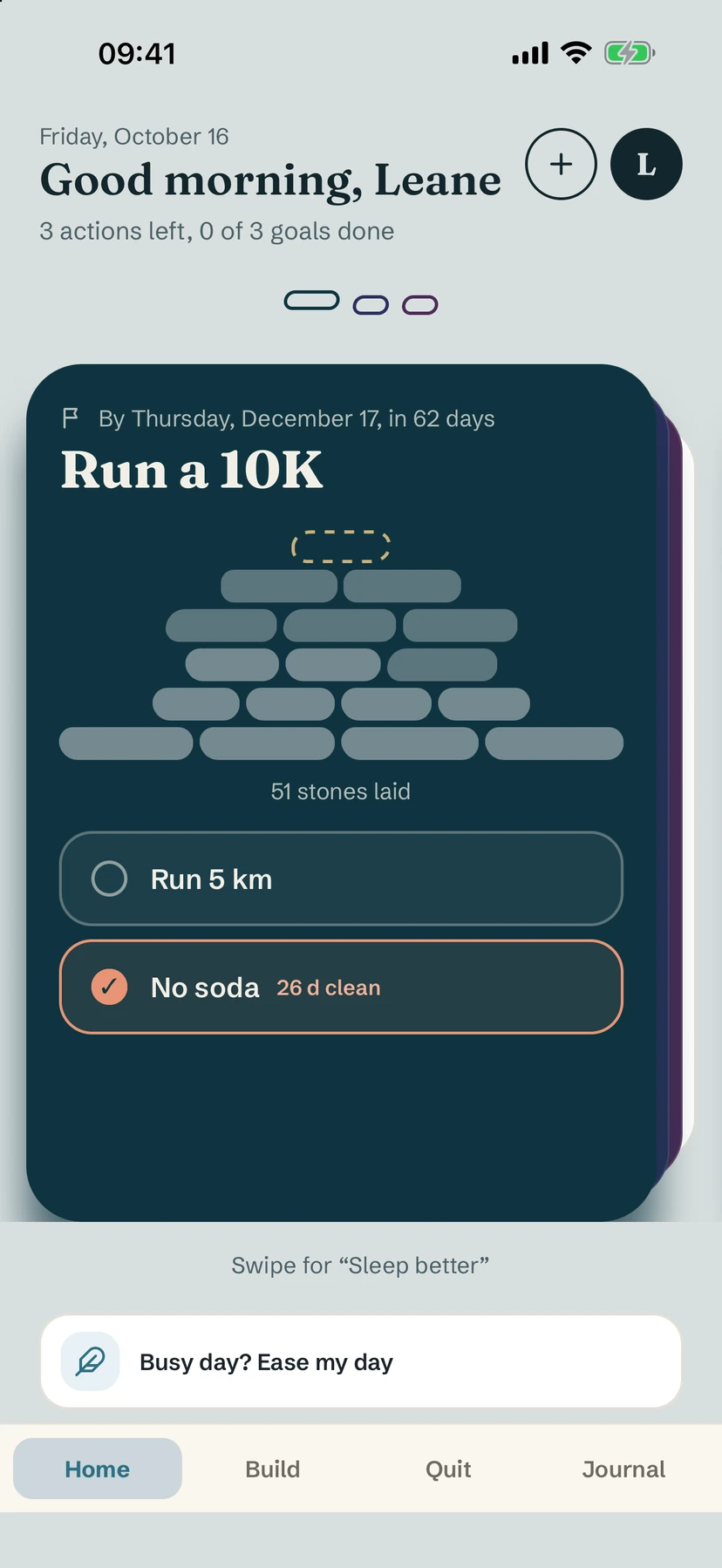
Yolmira has habit stacking built in. When you add or edit a habit, you can anchor it on one you already have — "after ☕ Coffee" — so the old habit becomes the reminder for the new one. Link both to a goal, and every day you do what the goal needs, a stone is laid on its cairn.
You can set each habit for every day, specific weekdays or a number of times a week, so the anchor matches your real routine. Everything stays on your phone, with no account.
Questions people ask
What is habit stacking?
Habit stacking means attaching a new habit to one you already do, using the formula 'After I [current habit], I will [new habit]'. The existing habit acts as the reminder.
Does habit stacking really work?
It's a form of implementation intention, or if-then planning, which meta-analyses of hundreds of studies have found reliably improves follow-through on goals.
How many habits can I stack at once?
Start with one new habit per anchor. Once it runs on its own, you can add another link to the chain.
Can habit stacking help me quit a bad habit?
Yes, by attaching a replacement action to the moment the old habit usually starts — for example, putting your phone face down when you feel the urge to check it.
Sources
- Gollwitzer, P. M., & Sheeran, P. (2006). Implementation intentions and goal achievement: A meta-analysis of effects and processes. Advances in Experimental Social Psychology, 38, 69–119.
- Sheeran, P., et al. (2024). The when and how of planning: Meta-analysis of the scope and components of implementation intentions in 642 tests. European Review of Social Psychology.
- Wood, W., & Rünger, D. (2016). Psychology of habit. Annual Review of Psychology, 67, 289–314.