- Motivation fluctuates for everyone. Habits are valuable precisely because they don't depend on it.
- When willpower is low, people tend to fall back on their habits — good and bad. Strong good habits keep you on track on bad days.
- On flat days, do the smallest version. It protects the habit without asking for motivation.
- Revisit your why occasionally, and change the plan if the reason has changed.
Every habit has its honeymoon. The first days are easy: you're excited, you can picture the result, you tick the box with pleasure. Then one morning you wake up and simply don't feel like it. Nothing happened — the motivation just isn't there. That morning is where most habits end. It doesn't have to be.
Losing motivation is normal
Motivation is a feeling, and feelings move. Sleep, stress, the weather, a hard week at work — all of it changes how much you want to do something. Waiting to feel motivated before acting means your habits will only happen on good days. And the good days are the ones that need them least.
The point of a habit is to stop needing that feeling.
What happens to habits when willpower is low
Research by Neal, Wood and Drolet (2013) looked at what people do when their self-control is depleted. They found that people fall back on their strongest habits, whatever they are: strong good habits held up, and so did strong bad ones.
That's the good news hidden in a bad day. If you've built a habit, it will tend to carry you through the moments when you have no motivation left. Reviews of habit research describe exactly this: habits run on cues, not on how you feel. The work you put in while motivated is what pays out when you're not.
On flat days, do the smallest version
When you don't feel like it, don't negotiate with yourself about the full version. Shrink it until saying no would feel silly:
- Instead of a run, put on your shoes and walk to the end of the street.
- Instead of a chapter, read one page.
- Instead of a journal entry, write one line.
The smallest version keeps the link between the cue and the action alive, and that link is the habit. Often, once you've started, you'll do more. If not, you still showed up.
Never miss twice
Some days, even the smallest version won't happen. That's fine. One missed day barely affects habit formation; what hurts is the slide from one missed day into a week. The rule that protects you: miss once if you must, but not twice in a row. Make the next day's version tiny if that's what it takes.
Revisit your why — and change it if needed
Sometimes a lack of motivation is a signal, not a slump. Maybe the goal no longer matters to you, or the habit doesn't serve it. Every few weeks, ask: why did I start this, and is it still true? If the answer has changed, change the plan. Dropping a habit that no longer fits your life isn't failure — it frees room for one that does.
Write one sentence: "I'm doing this because…". If it still rings true, keep the habit and shrink it for now. If it doesn't, rewrite the goal or let the habit go.
Make the good path easier than the bad one
On low days, you'll follow the path of least resistance. So design it: running clothes on the chair, the book on the pillow, the phone charging in another room, the biscuits not in the house. Friction is a quieter tool than motivation, and it works whether or not you feel like it. See how to break a bad habit for more on cues and friction.
A worked example: the third week slump
Someone started a morning stretch and a ten-minute evening walk at the beginning of the month. Week one was easy. In week three, a deadline arrives, sleep gets short, and both habits start to feel like chores. Instead of stopping, they:
- shrink the stretch to one minute next to the bed, and the walk to the end of the street;
- mark two days as light days while the deadline lasts, so nothing counts as failed;
- write one sentence on why they started: "I want my back to stop hurting." It still holds, so the habits stay.
When the deadline passes, the full versions come back — because the cue and the action never stopped being linked.
Common mistakes
- Waiting to feel motivated before starting. Often the feeling arrives a few minutes after you begin, not before.
- Raising the bar to "make up" for missed days. Doing double the next day makes the habit heavier exactly when it needs to be lighter.
- Reading a dip as proof you're "not the type". Everyone's motivation dips. The difference is having a plan for it.
- Relying on bursts of inspiration. A motivating video lasts an evening; a cue and a minimum version last a year.
Write your bad-day plan now
While you're reading this — probably not on your worst day — write one if-then line per habit:
If I don't feel like running, I put my shoes on and walk for five minutes.
If I'm too tired to read, I read one paragraph.
If I skipped my habit yesterday, today I do the smallest version first thing.
Decided in advance, these lines do the work that motivation can't on the days it's gone.
Motivation versus routine: what actually changes over time
In the first weeks, a habit runs mostly on intention: you remember it, decide to do it, and push through. Over time, if the cue and the action keep meeting, less deciding is needed. That's what habit formation means in practice — not that you suddenly love the activity, but that it stops requiring a negotiation.
That shift is gradual and uneven. Some days will feel automatic, others like week one again. Neither is a verdict. What tells you the habit is growing is the trend over weeks: fewer days where you had to argue with yourself, more days where you'd started before you'd thought about it.
So on a flat day, it helps to remember what you're actually doing: not "forcing yourself", but adding one more repetition to a link that's getting stronger each time.
How Yolmira helps
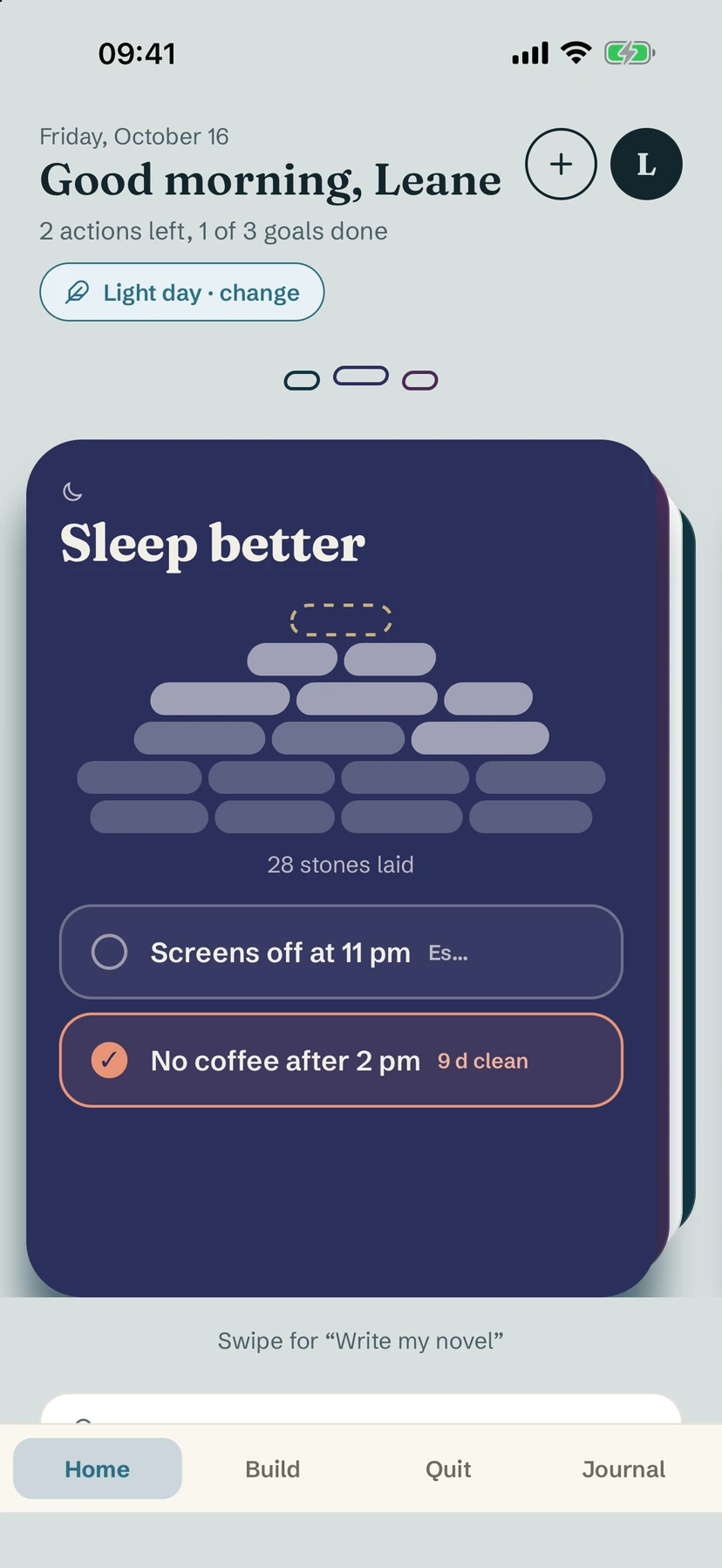
Yolmira is built for the days without motivation. Mark a light day or take leave for up to 30 days when life is heavy — neither breaks a streak or counts as missed. If a streak of three days or more breaks after a single miss, you can repair it: once a month for free, as often as you need with Yolmira Pro.
Each goal keeps your reason for it, so your why is one tap away, and its cairn of stones only ever grows. A gentle evening reminder keeps the day in view (it's on by default and easy to turn off), and a streak-saver nudge can tell you when a streak of three days or more is about to break — without guilt.
Questions people ask
What should I do when I have no motivation for my habits?
Do the smallest possible version — one page, one minute, shoes on — and avoid missing two days in a row. Habits are meant to work without motivation, and small repetitions keep them alive.
Is it normal to lose motivation after a few weeks?
Yes. Motivation naturally rises and falls with sleep, stress and circumstances. The early excitement of a new habit fades for almost everyone.
Do habits help when willpower is low?
Research suggests that when self-control is depleted, people fall back on their strongest habits. Good habits built earlier can carry you through low-willpower periods.
Should I quit a habit I've lost interest in?
Sometimes. If the reason you started no longer matters to you, changing or dropping the habit can be the right call. If the reason still matters, shrink the habit for a while instead.
Sources
- Neal, D. T., Wood, W., & Drolet, A. (2013). How do people adhere to goals when willpower is low? The profits (and pitfalls) of strong habits. Journal of Personality and Social Psychology, 104(6), 959–975.
- Wood, W., & Rünger, D. (2016). Psychology of habit. Annual Review of Psychology, 67, 289–314.
- Lally, P., van Jaarsveld, C. H. M., Potts, H. W. W., & Wardle, J. (2010). How are habits formed: Modelling habit formation in the real world. European Journal of Social Psychology, 40(6), 998–1009.