- Demanding habits like exercise usually take longer to become automatic than simple ones. Expect months, not weeks.
- Start with a version so small it feels almost silly: shoes on and a ten-minute walk counts.
- Enjoyment matters more than discipline. Pairing exercise with something you love — an audiobook you only hear while moving — measurably increased gym visits in one study.
- Tie it to a fixed moment with an if-then plan, and judge success by showing up, not by performance.
Most exercise advice is written by people who already like exercise. If you're not one of them, "just find your motivation" is useless. The good news: liking it isn't a requirement. Plenty of people who exercise regularly don't particularly enjoy it — they've simply made it easy, predictable and a little bit rewarding.
Why exercise is a hard habit to build
Exercise has everything working against it as a habit. It's effortful, the reward is delayed, and it competes with things that feel good right now. In Lally and colleagues' study of habit formation, demanding behaviours like doing sit-ups tended to take longer to become automatic than simple ones like drinking water. A 2024 review found the same: a median of about two months, with some people taking far longer.
So if exercise still feels like a negotiation after three weeks, that's not a sign you're "not a sporty person". It's what the early stage of an effortful habit feels like. More on that in how long it really takes to form a habit.
Start with the smallest version you'll actually do
The plan that fails is the ambitious one: five gym sessions a week from Monday. The plan that works is embarrassingly small. The goal of the first weeks isn't fitness — it's making "I'm someone who moves at this time of day" automatic.
- Put on your trainers and walk around the block.
- Do one round of stretching while the kettle boils.
- Cycle to one errand instead of driving.
If you feel like doing more, great. But the small version is the one that counts, and it's the one you fall back to on hard days. You can always grow a habit that exists.
Find movement you can tolerate — or even like
"Exercise" is a huge category. If you hate running, don't run. Dancing in the kitchen, swimming, a climbing wall, a long walk with a podcast, a football game with friends — they all count. The 2024 review found that people were more likely to keep behaviours they enjoyed, which sounds obvious until you notice how many plans start with the activity people dread most.
Try three or four kinds of movement for a week each and keep the one you mind least. "Least disliked" is a perfectly valid way to choose.
Pair it with something you look forward to
Researchers call this temptation bundling: you only allow yourself something you enjoy while doing the thing you're avoiding. In a study by Milkman, Minson and Volpp (2014), people who could only listen to gripping audiobooks at the gym went 51% more often than a comparison group, at least at first — the effect faded after a holiday break.
The next episode of your favourite podcast, only on walks.
That series you love, only on the exercise bike.
Your best playlist, only while stretching.
The fade is worth knowing: a bundle is a great starter, not a permanent engine. Its job is to get you through the weeks before the habit carries itself.
Give it a fixed moment
"I'll exercise when I have time" never arrives. Pick a moment and write it as an if-then plan: When I get home from work on Monday, Wednesday and Friday, I change straight into my running clothes. If-then plans are among the best-supported tools for following through. You don't need to exercise every day either — a habit set for specific weekdays or a number of times a week is still a habit.
Make the start frictionless: clothes laid out the night before, the bag by the door, the mat already unrolled.
Count showing up, not performance
Track whether you did it, not how far or how fast. Performance goals turn a slow day into a failure; showing up turns it into a success. When you miss a session — and you will — just make sure you don't miss two in a row. See why a missed day doesn't ruin a habit.
A worked example: from zero to three walks a week
Take someone who hasn't exercised in years and wants to "get fitter". Here is what a realistic first two months can look like:
- Weeks 1–2: On Monday, Wednesday and Friday, when I close my laptop, I put on my trainers and walk for ten minutes. Podcast only on these walks.
- Weeks 3–4: same moment, same cue, walk extends to fifteen or twenty minutes when it feels easy. On tired days, ten minutes still counts.
- Weeks 5–8: one of the three walks becomes a short jog-walk, or a swim, or a class — whatever has started to feel least unpleasant.
Notice what doesn't change: the moment, the cue, the minimum. Only the content grows, and only when the habit is already running.
Common mistakes
- Starting with the hardest version. Five sessions a week of something you dislike is the fastest route back to the sofa.
- Waiting to feel like it. Motivation comes after starting more often than before. Our guide on keeping habits without motivation goes into this.
- Treating soreness or a bad session as failure. The habit is the showing up; the workout is a bonus.
- Changing the time every week. A floating slot has no cue. Keep the moment fixed for at least the first month.
On a bad day
Decide your bad-day version in advance, so you don't have to negotiate when you're tired: If I'm exhausted when I get home, I'll still put my shoes on and walk to the end of the street. That's it. If you come back after five minutes, the habit still happened. If you can't even do that, make sure tomorrow's version is tiny — one miss is nothing, two in a row starts a new pattern.
How Yolmira helps
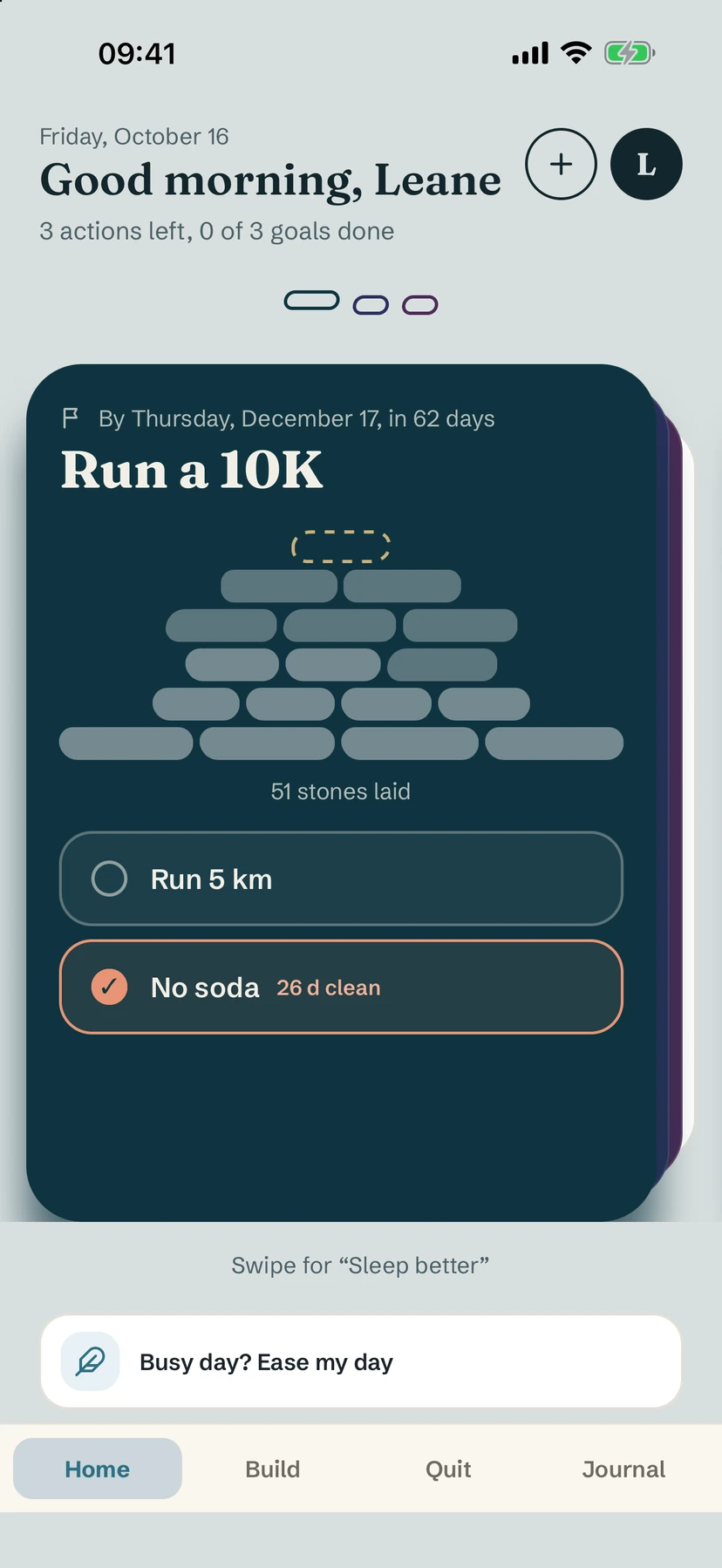
In Yolmira, you can set exercise as a habit on specific weekdays or a number of times a week, and link it to a goal like "Run a 10K" or "Feel stronger". Every day you do what the goal needs, a stone is laid on its cairn — and stones are never taken back. Reminders are yours to set at the moment you've chosen.
On heavy days, mark a light day so your plan eases without breaking anything, and if a streak breaks after a single miss, you can repair it. You can also anchor exercise on a habit you already have: after my morning coffee, I stretch for five minutes.
Questions people ask
How long does it take to make exercise a habit?
Usually longer than simpler habits. Research on habit formation suggests about two months on average for many behaviours, and effortful ones like exercise often take longer. Consistency matters more than the exact number of days.
What if I hate every kind of exercise?
Try several kinds of movement briefly and keep the one you mind least. Walking, dancing, cycling to errands or stretching all count. Pairing it with something you enjoy, like a podcast, can help in the early weeks.
Do I need to exercise every day to build the habit?
No. A habit can be set for specific weekdays or a number of times a week. What helps is a stable cue — the same moment on the days you've chosen.
What is temptation bundling?
Allowing yourself something you enjoy only while doing something you tend to avoid, such as listening to a favourite audiobook only while exercising. In a 2014 study it increased gym attendance, though the effect faded over time.
Sources
- Lally, P., van Jaarsveld, C. H. M., Potts, H. W. W., & Wardle, J. (2010). How are habits formed: Modelling habit formation in the real world. European Journal of Social Psychology, 40(6), 998–1009.
- Singh, B., et al. (2024). Time to form a habit: A systematic review and meta-analysis of health behaviour habit formation and its determinants. Healthcare, 12(23), 2488.
- Milkman, K. L., Minson, J. A., & Volpp, K. G. M. (2014). Holding the Hunger Games hostage at the gym: An evaluation of temptation bundling. Management Science.
- Gollwitzer, P. M., & Sheeran, P. (2006). Implementation intentions and goal achievement: A meta-analysis of effects and processes. Advances in Experimental Social Psychology, 38, 69–119.