- If you drink heavily every day, or have had shaking, sweating or anxiety when you stopped, don't stop suddenly: talk to a doctor first. Alcohol withdrawal can be dangerous.
- In a study of 857 people who signed up for a dry January, drinking was lower on average six months later — even among those who didn't finish the month.
- Plan the risky moments in advance with if-then sentences: Friday evenings, dinners, the drink after work.
- A slip isn't the end of the month. Note what happened and start counting again the next day.
Every year, many people decide to take a month off alcohol — often in January, sometimes before a holiday, after a heavy season or simply to see what happens. Some sail through. Many stop around day ten, usually on a Friday. The difference is rarely willpower. It's whether the month was planned like an experiment, with the hard moments thought through before they arrive.
First, is it safe for you to stop?
For most people who drink regularly but can go a few days without it, stopping for a month is safe. For some, it isn't. Guidance from NICE, the UK's health guidance body, explains that alcohol withdrawal ranges from poor sleep and shakiness to much more serious problems, which can be life-threatening — and that for people who are dependent, stopping in a planned way with medical help is safer.
Talk to a doctor before you start if you drink every day and find it hard to go without, if you drink in the morning, or if you've had shaking, sweating, anxiety or confusion when you stopped before. That's not a failure; it's the right first step.
What a month off can change
The best-known study followed people who signed up for a "Dry January". Richard de Visser and colleagues surveyed 857 participants before, right after and six months later. On average, they were drinking less six months on, and they felt more confident refusing a drink — and this was true even for people who didn't complete the month, though the changes were more likely among those who did. Very few drank more afterwards.
A smaller study by Gautam Mehta and colleagues compared 94 moderate-to-heavy drinkers who stopped for a month with 47 who carried on. The group who stopped showed lower insulin resistance, blood pressure and weight at the end of the month. People chose their own group, so this shows an association rather than proof — but it suggests a month can be long enough to notice a difference.
Plan the month before day one
- Pick your dates. Thirty days with a clear start and end is easier to commit to than "for a while". Look at the calendar: a wedding in week two isn't impossible, but it deserves a plan.
- Write down your reason. Better sleep, saving money, seeing how you feel, a change you've noticed. A reason in your own words is what you'll reread on day nine.
- Tell one or two people. Research on tracking suggests progress you share tends to stick better — and a friend who knows won't keep offering you a glass.
- Change what's at home. Move or give away what's in the fridge, and buy something you actually like drinking instead: sparkling water with citrus, an alcohol-free beer, a good tea.
- Find your risky moments. For most people it's a handful: Friday evening, dinners out, the drink that marks the end of the workday, being alone and tired.
If-then plans for the evenings out
Social pressure is where most dry months end. The most useful tool is a decision made in advance, written as an if-then plan:
If someone offers me a drink, then I say "I'm doing a dry month" and ask for a sparkling water.
If I arrive at a bar, then I order my non-alcoholic drink first, before anyone asks.
If I get home from work wanting a glass, then I make a cold drink and step outside for ten minutes.
If I'm tired and alone on a Friday, then I text a friend or start a film before I open the fridge.
You don't owe anyone a long explanation. "Not tonight" or "I'm doing a month off" is enough, and having a glass in your hand stops most of the offers.
When the craving comes
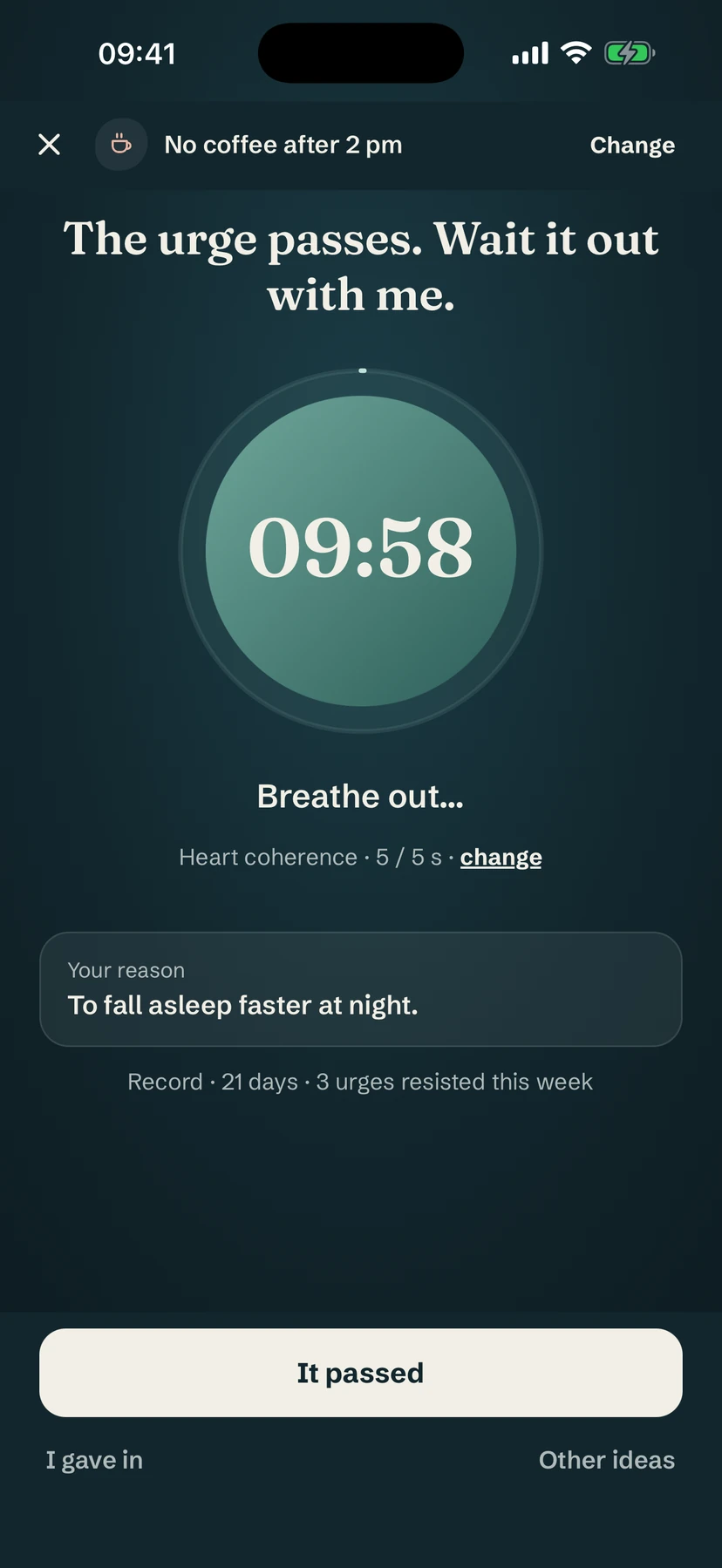
Cravings tend to come in waves: they build, peak and fade, often faster than it feels. When one arrives, don't argue with it. Notice it, name it ("that's the Friday craving"), take a few slow breaths and give it ten minutes before deciding anything. Our guide on riding out a craving explains the technique in detail.
Write down when cravings come. After a week or two, most people see a pattern — the same hour, the same kind of day — and a pattern is something you can plan around.
If you slip
A drink on day twelve doesn't erase the eleven days before it. In the de Visser study, the benefits at six months showed up even among people who didn't finish. The worst thing you can do is decide the month is over. Note what happened (where, with whom, what you felt), adjust your plan for that situation, and start counting again the next day. A month with one slip is still a very different month.
After the 30 days
Day thirty-one is a decision, not an automatic return. Look back at the month: how did you sleep, what did you spend, which moments were hardest? Some people go back to drinking as before; many keep a few habits — alcohol-free weekdays, a limit at dinners, a non-alcoholic drink first at parties. Choose on purpose, with what you learned in hand.
A worked example: four weeks
Week 1 — the novelty week. Motivation is high. The fridge is cleared, the reason is written down ("sleep through the night"), and two friends know. The hardest moment turns out to be 7 p.m., not the weekend.
Week 2 — the first Friday dinner. The if-then plan works: a non-alcoholic drink ordered first, one "no thanks", and it's over. Sleep is noticeably better.
Week 3 — the dip. Novelty is gone, and a stressful Thursday brings the strongest craving yet. Ten minutes, a walk, and it passes. This is usually the week to reread your reason.
Week 4 — the finish. Day thirty arrives almost quietly. The decision for afterwards: no alcohol on weeknights, and see how the weekends go.
Common mistakes
- Skipping the safety check. If you might be dependent, the first step is a doctor, not a challenge.
- Leaving the hard evenings to chance. "I'll see on the night" usually means the old habit decides.
- Nothing to drink instead. An empty hand at a party invites offers. Bring or order something you like.
- Treating a slip as the end. One drink is one day. Keep counting.
- Making up for it on day thirty-one. A big night to "celebrate" undoes the point. Plan the first drink, if there is one.
How Yolmira helps
In Yolmira, "No alcohol" can be a habit to quit, in its own tab. It counts your days clean, with freedom milestones at 7 and 30 days and beyond, and a relapse resets the count without any lecture. You can turn the month into a 30-day season and get a recap at the end.
When the craving hits, "Craving?" opens a calm ten-minute countdown with guided breaths and your own reason on screen. Every urge you resist is counted, and My cravings shows when they tend to come back. Everything stays on your phone, with no account — nobody else needs to know you're doing this unless you tell them.
Questions people ask
Is it safe to stop drinking for a month?
For most people who drink regularly but can go a few days without alcohol, yes. If you drink heavily every day, drink in the morning or have had withdrawal symptoms such as shaking or sweating, talk to a doctor first: stopping suddenly can be dangerous.
What happens to your body after a month without alcohol?
In one study of moderate-to-heavy drinkers, people who stopped for a month had lower insulin resistance, blood pressure and weight at the end of it than people who kept drinking. It was an observational study, so the results show an association rather than proof.
Is a dry month worth it if I don't finish?
Research suggests so. In a study of 857 people who took part in a dry January, drinking was lower on average six months later, even among those who didn't complete the month.
How do I say no to a drink at a party?
Decide in advance and keep it short: "I'm doing a dry month" or "not tonight" is enough. Ordering a non-alcoholic drink first means fewer people offer you one.
What should I do if I drink during my dry month?
Don't call the month off. Note what happened and who you were with, adjust your plan for that situation and start counting again the next day.
Sources
- de Visser, R. O., Robinson, E., & Bond, R. (2016). Voluntary temporary abstinence from alcohol during "Dry January" and subsequent alcohol use. Health Psychology, 35(3), 281–289.
- Mehta, G., Macdonald, S., Cronberg, A., Rosselli, M., Khera-Butler, T., Sumpter, C., et al. (2018). Short-term abstinence from alcohol and changes in cardiovascular risk factors, liver function tests and cancer-related growth factors: a prospective observational study. BMJ Open, 8(5), e020673.
- National Institute for Health and Care Excellence (2011). Alcohol-use disorders: diagnosis, assessment and management of harmful drinking (high-risk drinking) and alcohol dependence. Clinical guideline CG115.
This guide is general information, not medical advice. If you drink every day, find it hard to stop, or have had withdrawal symptoms such as shaking, sweating, anxiety or confusion, talk to a doctor before stopping: alcohol withdrawal can be dangerous. A doctor, a pharmacist or a local alcohol support service can help in ways an app cannot.