- In a meta-analysis of 138 studies, people prompted to monitor their progress were more likely to reach their goals — and the effect was larger when they wrote it down.
- Track the behaviour you control ("walk 20 minutes"), not only the result you hope for ("lose 5 kg").
- Start with one to three habits and a check-in that takes under ten seconds. A tracker you dread opening is a tracker you'll abandon.
- Look at the pattern over weeks, not the streak. Missing a single day did not measurably derail habit formation in the best-known study.
Almost everyone who has tried to change a habit has started a tracker. A grid in a notebook, a spreadsheet, an app with a satisfying tick. And almost everyone has a few abandoned ones behind them — full for two weeks, then blank. That's a shame, because tracking is one of the few tools in habit change with solid evidence behind it. The trick is to set it up so it survives an ordinary, busy month.
Why tracking works
In 2016, Benjamin Harkin and colleagues pooled 138 experiments with almost 20,000 participants, most of them about health goals like eating better, exercising or quitting smoking. People who were prompted to monitor their progress were more likely to reach their goals, and monitoring more often was associated with bigger effects. Two details matter for anyone setting up a tracker: the effect was stronger when progress was physically recorded, and when it was reported to someone else.
Another large analysis, by Susan Michie and colleagues, looked at what made healthy eating and exercise programmes effective. Self-monitoring stood out — and it worked best when it came with at least one other technique, such as setting a specific goal, getting feedback, or reviewing the goal from time to time. In other words: a tracker on its own helps; a tracker you look at and act on helps more.
What to track
- Behaviours, not only results. You decide whether you walk today; you don't decide what the scale says this week. In Harkin's analysis, monitoring a behaviour mostly changed the behaviour, and monitoring an outcome mostly changed the outcome. Track the walk; check the scale less often.
- One to three habits. Ten rows feel ambitious on day one and like a report card by day ten. Add a habit when the first ones feel easy, not before.
- A clear "done". "Exercise more" can't be ticked. "Walk 20 minutes after lunch" can. If a habit is big, define a minimum version that still counts on a bad day — five minutes, one page, one glass of water.
- Habits to stop count differently. For something you're quitting, the useful number is days without it, not a daily tick. Count the days clean and note what happened when you slipped.
When and how to check in
The best moment to record a habit is right after doing it: the tick becomes the last step of the habit itself. If that's not practical, pick one fixed moment a day — after dinner, before brushing your teeth — and review the day in one go. Tie it to something you already do, so the check-in becomes a small habit of its own.
Make it fast. If logging takes more than ten seconds, you'll skip it on exactly the days you most need the data. Keep notes optional: one line when something interesting happens ("skipped — late meeting"), nothing the rest of the time.
Habit · Mon Tue Wed Thu Fri Sat Sun
Walk 20 min after lunch · ✓ ✓ – ✓ ✓ ✓ –
Read 2 pages in bed · ✓ ✓ ✓ ✓ – ✓ ✓
No phone in bed (days clean) · 1 2 3 0 1 2 3
Paper or app?
Both work; the right one is the one you'll actually open every day.
- Paper is visible, satisfying and screen-free. A sheet on the fridge doubles as a reminder. It's weaker away from home, it doesn't add anything up for you, and it's awkward for habits you're quitting.
- An app is always in your pocket, can remind you at the right time and turns weeks of ticks into a score and a chart. The risks are the opposite: notifications that nag, a phone that pulls you into everything else, and data you hand to a company. If you go that way, our guide on choosing a habit tracker app lists what to look for.
Read the data once a week
Recording is half of the technique; the other half is looking. Once a week, take five minutes:
- What's your consistency? "5 out of 7 days" or "70% over the month" tells you far more than whether the streak survived.
- Where are the gaps? Same weekday? Same kind of day? Gaps usually point to a plan that doesn't fit, not to a lack of willpower.
- What's one change for next week? Move the habit to another moment, shrink it, or link it to a stronger cue. One change, not five.
When you miss a day
A blank square isn't a verdict. In the best-known study on habit formation, by Phillippa Lally and colleagues, missing a single opportunity did not materially affect how the habit developed. What hurts is the reaction: deciding the week is ruined, or that the tracker proves you can't do it. Mark the day honestly, then do the habit the next day. Our guide on missing a day goes further.
A worked example: the first month
Week 1 — two habits, no pressure. "Walk 20 minutes after lunch" and "Read two pages in bed". Ticks go in right after each one. Result: 5/7 and 6/7.
Week 2 — notice the pattern. Both walks missed were on days with a lunch meeting. The habit isn't failing; the timing is.
Week 3 — one adjustment. On meeting days, the walk moves to after work. Consistency rises to 6/7.
Week 4 — add one thing. The first two feel easy, so a third habit joins: a habit to quit, "no phone in bed", counted in days clean. The tracker grows with you instead of starting at its biggest.
Common mistakes
- Tracking everything at once. The more rows, the sooner the tracker becomes a chore.
- All-or-nothing ticks. If only the full version counts, bad days give you nothing to record. Let the minimum version count.
- Worshipping the streak. A long streak can turn into anxiety, and its end into an excuse to stop. Watch the consistency instead.
- Never looking back. Data you don't read changes nothing. The weekly five minutes is where the tracker earns its place.
- Restarting from zero after a gap. Pick up where you are; the past weeks still count.
How Yolmira helps
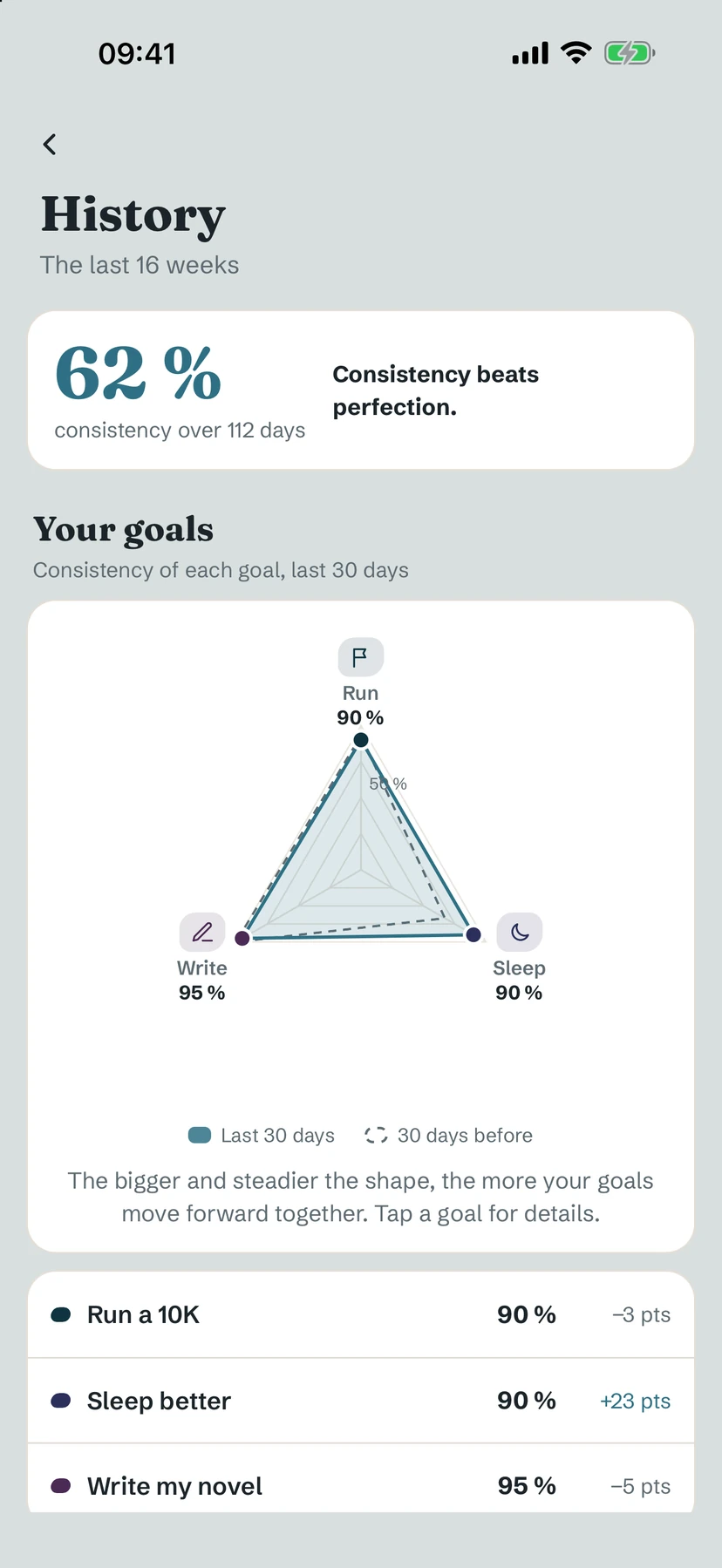
Yolmira is built around this kind of tracking. A check-in is one tap, and a ring fills as the day goes. A habit can be due every day, on certain weekdays or a number of times a week — the ring only counts what's actually due, so a rest day isn't a miss. Habits you're quitting live in their own tab and are counted in days clean.
The weekly look happens on its own: every Sunday evening, a short recap shows your consistency score, the habit you kept best and your longest current streak. History shows the longer picture, and a missed day can be forgiven with a streak repair instead of erasing what you built. You can add one note per habit per day when something's worth remembering. Everything stays on your phone, with no account and no ads.
Questions people ask
Does tracking habits actually work?
Research suggests it does. A 2016 meta-analysis of 138 studies found that monitoring progress made people more likely to reach their goals, especially when progress was written down or shared with someone.
How many habits should I track at once?
Start with one to three. Add another only when the first ones feel easy. Trackers with many rows are usually the first to be abandoned.
Is a paper habit tracker better than an app?
Neither is better in general. Paper is visible and screen-free; an app is always with you, can remind you and does the counting. Choose the one you will open every day.
What should I do if I miss a day in my habit tracker?
Mark it honestly and do the habit the next day. In the best-known study on habit formation, missing a single opportunity did not materially affect the result.
Should I track my streak or my consistency?
Consistency over weeks is more useful than a streak. It shows the pattern, survives a missed day and doesn't turn every gap into a reset.
Sources
- Harkin, B., Webb, T. L., Chang, B. P. I., Prestwich, A., Conner, M., Kellar, I., Benn, Y., & Sheeran, P. (2016). Does monitoring goal progress promote goal attainment? A meta-analysis of the experimental evidence. Psychological Bulletin, 142(2), 198–229.
- Michie, S., Abraham, C., Whittington, C., McAteer, J., & Gupta, S. (2009). Effective techniques in healthy eating and physical activity interventions: A meta-regression. Health Psychology, 28(6), 690–701.
- Lally, P., van Jaarsveld, C. H. M., Potts, H. W. W., & Wardle, J. (2010). How are habits formed: Modelling habit formation in the real world. European Journal of Social Psychology, 40(6), 998–1009.