- Cravings often arrive at the same time and place each day — the afternoon slump, the walk past the vending machine, the sofa after dinner.
- Tiredness matters. Research suggests that after a short night, the brain's response to tempting, high-calorie food goes up.
- A craving is a wave: it rises and fades. Waiting ten minutes and breathing slowly often lets it pass.
- Plan a replacement for the moment the craving usually hits, rather than relying on saying no.
This isn't a guide about cutting things out of your diet. It's about the moment — usually the same moment every day — when you suddenly need something sweet, and how to get through it without turning it into a battle with yourself.
Notice when it happens
For a week, don't change anything. Just note when the craving shows up: the time, where you are, what you were doing, how you felt. Most people find a pattern quickly. The 3–4 p.m. slump at the desk. Walking past the bakery on the way home. The sofa after dinner. A stressful phone call.
That pattern is the point. Diary studies of everyday behaviour suggest that much of what we do daily is repeated in the same context, often without thinking. Your craving may be less about sugar than about 4 p.m.
Tiredness makes it louder
If the cravings are worse after a bad night, you're not imagining it. In a brain-imaging study, Greer, Goldstein and Walker (2013) found that after a night without sleep, people's desire for high-calorie foods rose, along with stronger responses in reward-related brain areas and weaker activity in regions involved in weighing choices. It's one study, but it fits what many people notice: a tired brain wants a quick reward.
So part of a sugar plan is a sleep plan. If you're scrolling until midnight, start there — see how to stop scrolling in bed.
Ride the wave
When the craving hits, try not to argue with it. Arguing keeps it in the spotlight. Instead:
- Name it. "This is the 4 p.m. craving. It passes."
- Set a ten-minute timer. You're not saying never — just not yet.
- Breathe slowly, with out-breaths longer than in-breaths.
- Move. Stand up, refill your water, step outside.
- Then decide. Sometimes you'll still want it, and that's fine. Often you won't.
This is a version of urge surfing, a technique from relapse-prevention research; in one study with smokers, learning to observe cravings this way reduced how much people smoked. More in our guide on breaking a bad habit.
Plan the replacement, not the restriction
A habit usually does a job. The afternoon biscuit is a break, a small reward, an excuse to stand up. Keep the job and change the action. Write it as an if-then plan:
If it's 4 p.m. and I want something sweet, then I make a tea and walk around the block.
If I'm stressed after a call, then I stand by the window for two minutes before doing anything else.
If I'm passing the bakery, then I cross the street.
And make the old path a little longer: biscuits on a high shelf or not in the house, fruit on the desk. Friction doesn't forbid anything; it just gives the craving time to pass.
Be kind about the days it wins
Some afternoons the craving will win. That's normal, and it's useful data: what was different that day? Treating one biscuit as proof you've failed is what turns it into the whole packet. Researchers call that spiral the abstinence violation effect, and simply knowing it exists makes it easier to step out of.
A worked example: the 4 p.m. biscuit
Take someone who eats biscuits from the office kitchen every afternoon and wants to stop.
The pattern. After a week of noting it down, the picture is clear: it happens between 3:30 and 4:30, mostly on days with back-to-back meetings, and almost always right after walking past the kitchen on the way back from the printer.
The plan. Three small changes. A different route back from the printer. A flask of tea on the desk, so the kitchen isn't the only place to get a warm drink. And one if-then sentence: If I feel the 4 p.m. dip, then I go outside for five minutes before deciding anything.
The result after two weeks. Not zero biscuits. Some days the meeting ran long and the urge won. But most afternoons, the five minutes outside did the job the biscuit used to do — a break, a change of air — and the urge didn't come back. That's what success looks like here: fewer, not none, and without a fight.
What to do on a bad day
Some days everything conspires: a short night, a stressful morning, someone brings cake. On those days, lower the bar rather than giving up:
- Keep just one part of the plan. Maybe the walk doesn't happen, but you still wait ten minutes before deciding.
- Eat it on purpose. If you're going to have something sweet, sit down and enjoy it, rather than eating it standing at the counter while reading emails.
- Look after the cause. If tiredness is driving it, the best move for tomorrow's afternoon is an earlier night tonight.
If someone brings sweets to the office, then I take one and eat it at my desk, slowly — not three standing by the box.
If I'm shopping when I'm hungry, then I eat something first or keep to the list.
If I notice I'm craving sugar after a bad night, then I go to bed half an hour earlier that evening.
Track the urges, not just the slips
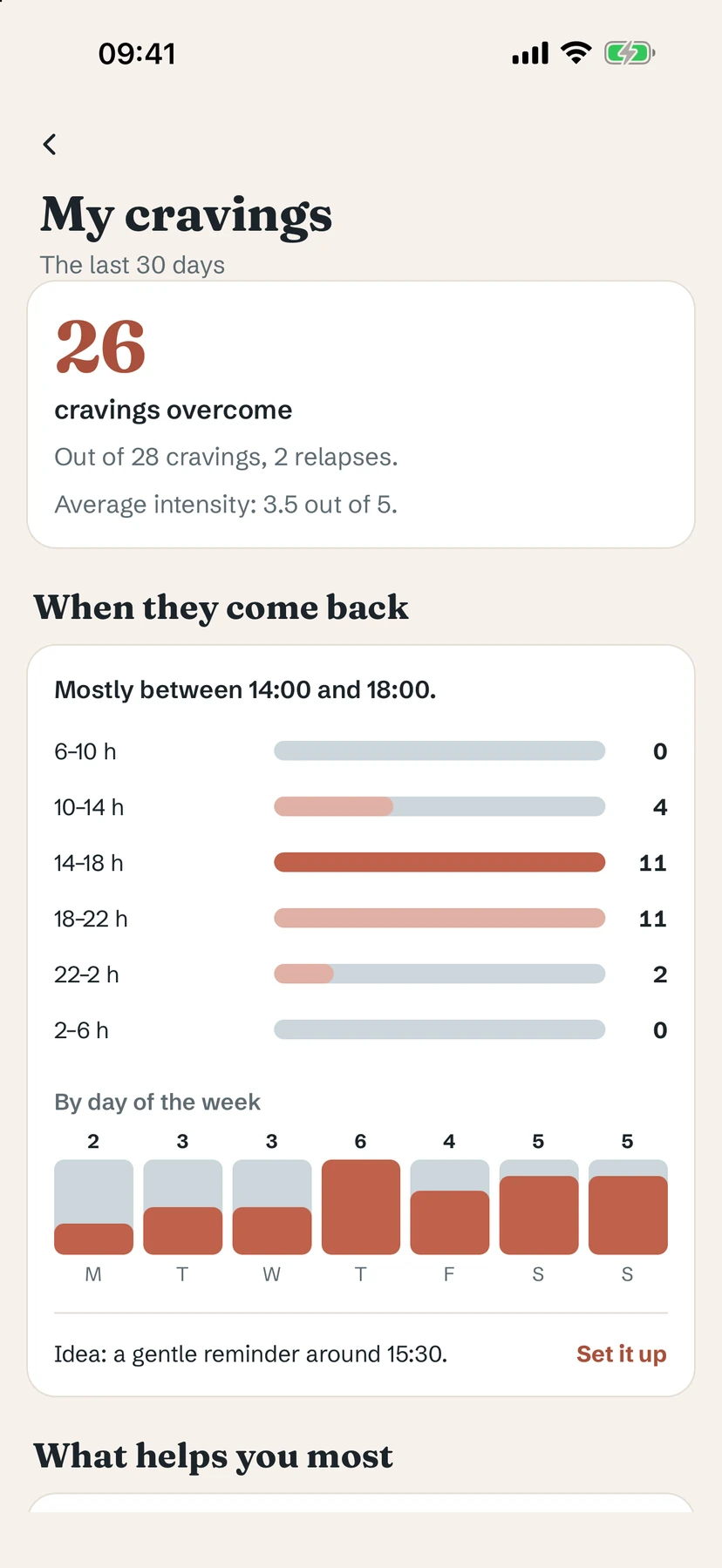
When you're cutting back on something, it's natural to count the days you gave in. But that number only ever goes one way, and it hides the most useful information. Try counting the cravings you got through as well. After a couple of weeks, you'll see two things: the count of urges resisted climbing steadily, and the times they cluster around. That second part is what lets you plan — a walk scheduled at 3:45 p.m., tea already on the desk, the bakery route avoided. And the first part is simply encouraging. Every urge you let pass is practice, and practice is what turns a new response into the default one.
How Yolmira helps
In Yolmira you can track "No sweets in the afternoon" as a habit to quit, counted in days clean. When a craving hits, the craving screen — always free — gives you a calm ten-minute timer, a few breathing rhythms and your own reason, in your words. Saying it passed counts as an urge resisted.
My cravings then shows how many urges you've got through and when they come back, by hour and by weekday — exactly the pattern you need to plan around. Pair the quit habit with something to build, like a short walk after lunch, and link both to a goal such as "More energy". It all stays on your phone.
Questions people ask
Why do I crave sugar in the afternoon?
Afternoon cravings often follow a routine — a slump at the desk, a break, a walk past a shop — and tiredness can make them stronger. Noting when they happen usually reveals the pattern.
Does lack of sleep make sugar cravings worse?
Research suggests it can. A 2013 brain-imaging study found that after a night without sleep, people's desire for high-calorie foods increased.
How long does a sugar craving last?
Cravings rise, peak and fade, often within minutes. Waiting ten minutes while doing something else is often enough to let one pass.
What can I do instead of eating sugar when a craving hits?
Keep the job the habit was doing — a break, a reward, a pause — and change the action: a tea, a short walk, a few minutes outside. Plan it in advance as an if-then sentence.
Sources
- Wood, W., Quinn, J. M., & Kashy, D. A. (2002). Habits in everyday life: Thought, emotion, and action. Journal of Personality and Social Psychology, 83(6), 1281–1297.
- Greer, S. M., Goldstein, A. N., & Walker, M. P. (2013). The impact of sleep deprivation on food desire in the human brain. Nature Communications, 4, 2259.
- Bowen, S., & Marlatt, G. A. (2009). Surfing the urge: Brief mindfulness-based intervention for college student smokers. Psychology of Addictive Behaviors, 23(4), 666–671.
- Marlatt, G. A., & Gordon, J. R. (Eds.). (1985). Relapse prevention: Maintenance strategies in the treatment of addictive behaviors. Guilford Press.
This guide is general information, not medical or nutritional advice. If you live with a condition such as diabetes, or if eating often feels out of your control, a doctor, a dietitian or an eating-disorder support service can help in ways an app cannot.