- Late-night snacking is often cued by the routine — the sofa, the series, the end of the day — more than by hunger.
- Tiredness tends to make tempting food more appealing, so evenings are when it's hardest.
- Change the scene: close the kitchen after dinner, keep snacks out of sight, give your hands something else to do.
- This isn't about strict rules. If eating feels out of your control, talk to a doctor or a specialist service.
Dinner was fine. You weren't hungry an hour ago. And yet at 10 p.m., halfway through an episode, you're standing at the open fridge. Late-night snacking is one of the most common habits people want to change, and one of the most misunderstood. It's rarely about food, and almost never about willpower.
This guide isn't about dieting or cutting things out. It's about the evening routine, and how to reshape it so the fridge stops calling.
It's the routine, not the hunger
Evening snacking is a textbook habit: the same place (the sofa), the same time (after dinner), the same companion (a screen), often the same feeling (tired, bored, winding down). Research on how habits work suggests that once those cues are linked to an action, the situation triggers it before you've decided anything.
A useful check: next time you head to the kitchen, ask "would I eat an apple right now?" If the answer is no, it's probably not hunger. It's the routine.
Why evenings are hardest
By late evening you've spent a day making decisions, and you're tired. Research suggests tiredness changes how we respond to food: in a 2013 study, people who had missed a night of sleep showed a stronger desire for high-calorie foods. The practical lesson isn't to be stricter at 10 p.m. — it's to make the evening easier, and perhaps to go to bed a little earlier.
Change the scene
- Close the kitchen. After dinner, wash up, wipe the counter and turn off the kitchen light. A small ritual that says "done for the day".
- Out of sight. Keep snacks in a cupboard rather than on the counter, or don't keep the ones you reach for most at home.
- Hands busy. A cup of herbal tea, a puzzle, stretching on the floor — something to do while you watch.
- Brush your teeth earlier. For many people, it's a natural full stop to eating.
Plan the evening with if-then sentences
If-then plans are among the best-supported tools for changing a behaviour. Write two or three for your evenings:
If I finish dinner, then I make a pot of herbal tea and close the kitchen.
If I get up during an episode, then I fill my water glass and go back.
If I still want something after ten minutes, then I have it at the table, not on the sofa.
Notice the last one. It doesn't forbid anything. It just changes the setting, which is often enough to change the habit.
Let the urge pass
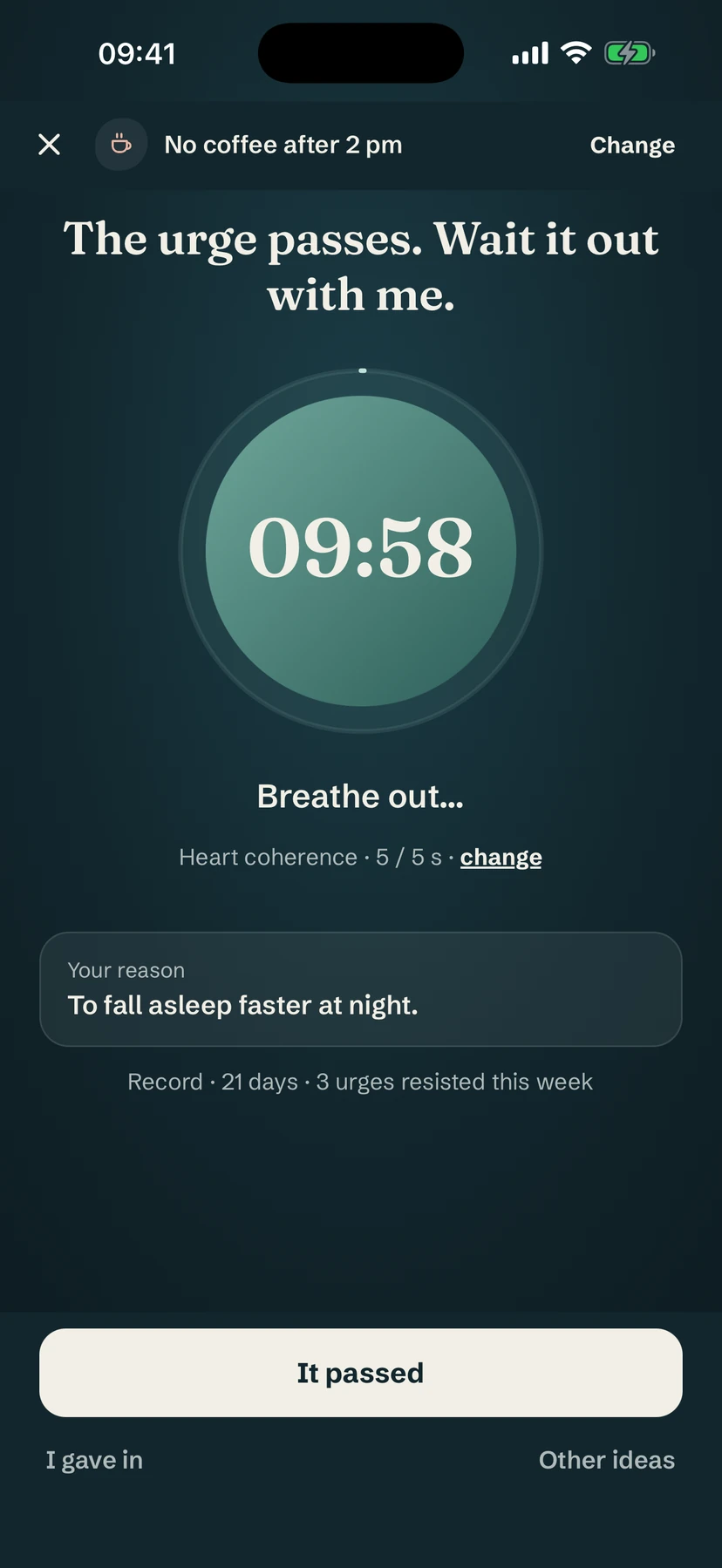
When you feel the pull toward the kitchen, try waiting ten minutes and breathing slowly. Urges tend to rise, peak and fade — our guide on riding out a craving explains why. And if you do have a snack, that's fine. One evening is not a pattern, and treating it as a failure is what makes it one.
When it's more than a habit
For some people, eating at night comes with a sense of losing control, or with distress afterwards. If that sounds like you, you deserve proper support: a doctor or a specialist eating-disorder service can help in ways a habit guide can't.
A worked example: a new evening shape
Here is how one evening routine might change over a couple of weeks, without any strict rules.
Before. Dinner at 7:30, dishes left for later, sofa by 8:30 with a series, first trip to the kitchen around 9:30, second around 10:30. Bed at midnight, tired.
After. Dinner at 7:30, then ten minutes of washing up and wiping the counter — the "closing the kitchen" ritual. A pot of herbal tea goes on the coffee table. Teeth brushed at 9:30, during a natural break between episodes. Phone and remote both put away at 11.
Nothing is forbidden in the second version. There's simply less reason to get up, and more things that say "the eating part of the day is over". Most nights that's enough. Some nights it isn't, and that's fine too.
What to do on a hard evening
Some evenings come after a long, draining day, when the pull toward the kitchen is strongest. On those evenings:
- Eat a proper dinner. Skipping or shrinking dinner to "make up" for something often makes the evening harder, not easier.
- Choose the setting, not the rule. If you want something, put it on a plate and eat it at the table. You'll notice it more and need less of it.
- Go to bed earlier. Tiredness makes evenings longer and harder. Sometimes the kindest plan is simply to end the day.
- Write one line. A note about how the day went can take the edge off the need to "reward" yourself with food.
If I've had a stressful day, then I take a shower before sitting down on the sofa.
If I'm bored during a series, then I stretch on the floor for the next five minutes.
If I open the fridge without being hungry, then I close it and pour a glass of water instead.
If you really are hungry in the evening
Sometimes evening snacking is a sign that the day's meals aren't quite working: a light lunch, a long gap before dinner, a dinner eaten in a rush. If you notice you're genuinely hungry most evenings, the answer isn't to resist harder at 10 p.m. — it's to look at the earlier part of the day. A more filling lunch, an afternoon snack you choose in advance, or a dinner that isn't eaten standing up can quietly take the pressure off the evening. The aim is an evening where you can eat if you're hungry and rest if you're not, without the kitchen becoming the default answer to tiredness or boredom.
How Yolmira helps
In Yolmira you can add "Kitchen closed after dinner" as a habit to build, or "No snacks on the sofa" as one to quit — whichever framing feels kinder to you. When the urge hits, the craving screen opens a calm ten-minute timer with slow breathing and your own reason. It's always free.
The evening journal lets you note how the day went and set a "Tomorrow, I…" intention, and My cravings shows when the urges tend to come back. Everything stays on your phone, with no account.
Questions people ask
Why do I snack at night when I'm not hungry?
Evening snacking is often triggered by the routine — the sofa, a screen, the end of the day — and by tiredness, rather than by hunger.
How do I stop eating in front of the TV?
Change the scene: close the kitchen after dinner, keep snacks out of sight and give your hands something else to do, like a cup of tea. If you still want something, eat it at the table.
Does tiredness make late-night snacking worse?
Research suggests it can. A 2013 study found that sleep deprivation increased people's desire for high-calorie foods.
When should I get help for night eating?
If eating at night feels out of your control or leaves you distressed, talk to a doctor or a specialist eating-disorder service.
Sources
- Wood, W., & Neal, D. T. (2007). A new look at habits and the habit–goal interface. Psychological Review, 114(4), 843–863.
- Greer, S. M., Goldstein, A. N., & Walker, M. P. (2013). The impact of sleep deprivation on food desire in the human brain. Nature Communications, 4, 2259.
- Gollwitzer, P. M., & Sheeran, P. (2006). Implementation intentions and goal achievement: A meta-analysis of effects and processes. Advances in Experimental Social Psychology, 38, 69–119.
This guide is general information, not medical or nutritional advice. If you live with a condition such as diabetes, or if eating often feels out of your control, a doctor, a dietitian or an eating-disorder support service can help in ways an app cannot.