- Impulse buying has been described as a sudden, powerful urge to buy now — closer to a craving than to a decision.
- The 48-hour rule: add it to a list and wait two days. If you still want it, buy it. Many urges simply disappear.
- Friction works: delete saved cards, unsubscribe from sale emails, log out of shopping apps.
- A concrete savings goal gives "not now" a reason. Track the days you stuck to it, not just the euros.
It was on sale. It was the last one. It would make your mornings better. Ten minutes later it's paid for, and a week later it's in a drawer. Impulse buying is common, and it isn't a sign that you're bad with money. It's a habit with a cue, a craving and a reward — and it can be changed like one.
An urge, not a decision
In a classic study of how people describe it, Dennis Rook (1987) characterised impulse buying as a sudden, often powerful and persistent urge to buy something immediately. People in his study described it as feeling almost spontaneous — the purchase happened before the thinking did.
That's useful to know, because urges have a shape: they rise, peak and fade. If you can put time between the urge and the payment, the urge often loses.
The 48-hour rule
The simplest tool is also the most effective: when you want something you hadn't planned to buy, add it to a list and wait 48 hours. If you still want it after two days, buy it — no guilt. If you've forgotten about it, the urge has done its job and left.
Make the list somewhere you'll see it — a note on your phone, a page in a notebook. Over a few weeks, it becomes a surprisingly honest record of what you actually value.
Add friction to the path
Online shopping is designed to remove every step between wanting and paying. Put a few back:
- Delete saved cards from shopping sites and apps. Typing sixteen digits is a small pause that changes a lot.
- Unsubscribe from sale emails and turn off shopping-app notifications. Each one is a cue designed to start an urge.
- Log out and remove shopping apps from your home screen.
- Leave the basket overnight. If you're about to check out after 10 p.m., wait until morning.
Find your trigger
Like other habits, impulse buying tends to follow a pattern. Boredom on the sofa, a stressful day, payday, scrolling in bed. For a couple of weeks, when you feel the pull, note what's going on. You'll probably find one or two situations that account for most of it — and those are the ones to plan for with an if-then sentence.
If I want to buy something I hadn't planned, then I add it to my 48-hour list.
If I open a shopping app because I'm bored, then I close it and go for a ten-minute walk.
If my salary arrives, then I move my savings first, before anything else.
Give "not now" a reason
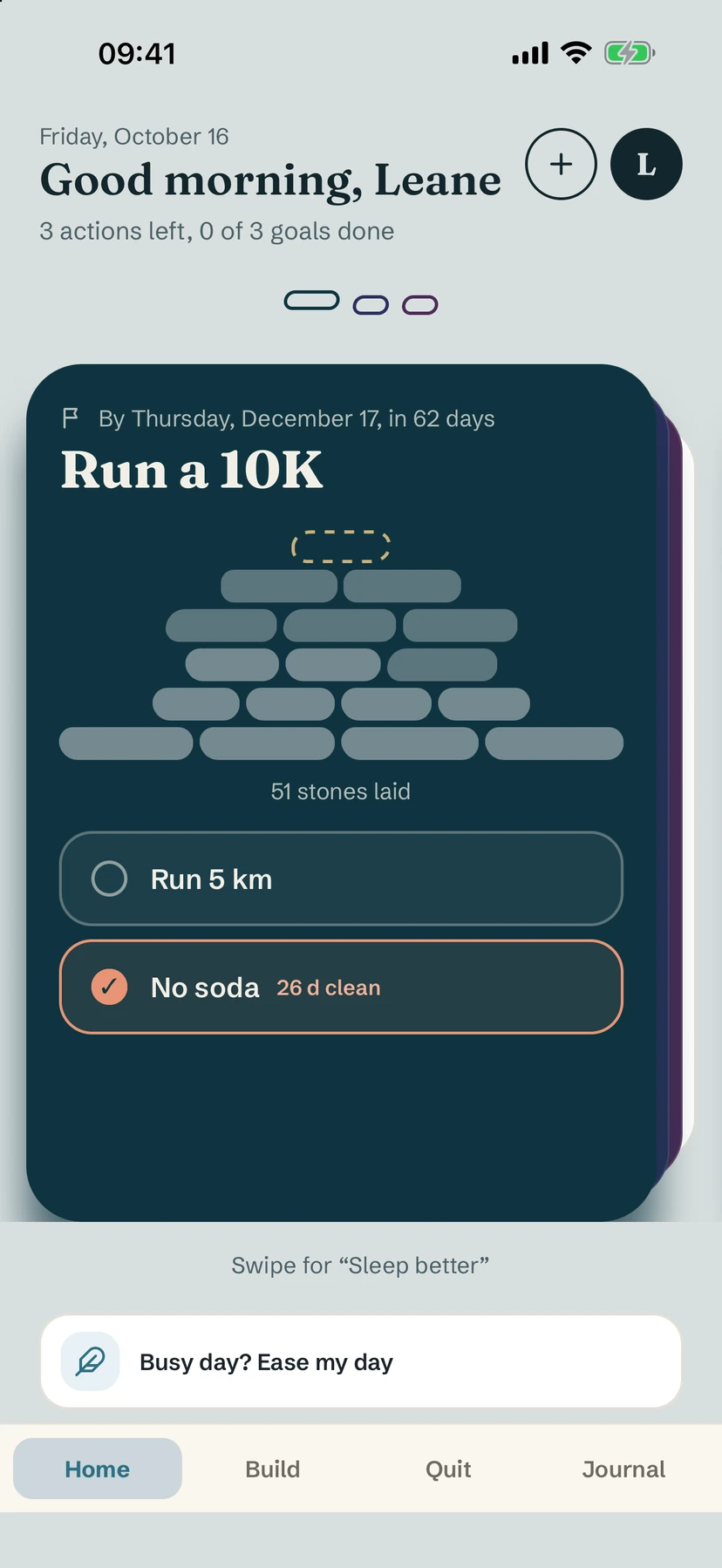
Saying no to a purchase is easier when you're saying yes to something else. A concrete goal — "Save €1,000 by June", "A trip in the summer" — turns a vague intention into a reason. Then break it into habits: something to build (move €5 to savings every weekday) and something to stop (no food delivery after 9 p.m., no shopping apps in bed). Our guide on turning goals into habits walks through it.
Count the days you stuck to the plan, not only the balance. Money moves slowly; a run of good days is visible right away.
When you buy anyway
You will. The useful question isn't "why am I like this" but "what was the cue?" Note it, return what you can, and carry on tomorrow. One purchase doesn't undo the habit — giving up does.
A worked example: the payday spiral
Consider someone who saves well for three weeks a month, then loses most of it in the days after payday.
The pattern. Their 48-hour list shows it plainly: almost everything on it was added on the 28th, 29th or 30th, usually in the evening, usually from the same two shopping apps.
The plan. First, savings move automatically the morning the salary arrives, so the money they want to keep isn't sitting in the current account. Second, the two apps come off the phone for the last week of the month. Third, one if-then line: If it's payday week and I want to buy something, then it goes on the list and I decide on the 5th.
The result. Some items on the list still get bought on the 5th — and that's fine, because they were wanted. Most quietly disappear. The savings goal, which had stalled for months, starts moving again.
Common mistakes
- Banning all non-essential spending. Rules that strict tend to break all at once. A budget for things you enjoy, spent deliberately, is easier to keep.
- Counting only money. Balances move slowly and can be discouraging. Count the days you followed your plan; the money follows.
- Treating sales as savings. Spending €60 on a €100 item you didn't need isn't saving €40. The question is whether you'd buy it at full price.
- Hiding a purchase from yourself. If you bought something on impulse, write it on the list anyway. The pattern is more useful than the guilt.
If an item is "only available today", then I treat it as if it were available forever and wait 48 hours.
If I'm about to pay after 10 p.m., then I close the tab and look again in the morning.
If a package arrives that I don't love, then I return it the same week.
When the people around you shop for fun
Spending is often social: a friend who loves browsing, a group chat sharing deals, weekends that default to the shopping centre. You don't need to give any of that up, but it helps to decide your approach in advance. Suggest a walk or a coffee instead of a shopping trip now and then. Mute deal-sharing chats for a while. And when you do go shopping with friends, take your 48-hour list with you rather than your card details saved on your phone — you can enjoy the outing, note what you liked, and decide later. Most people find that the fun was mostly in the company, not the purchase.
How Yolmira helps
In Yolmira, start with a goal — say "Save €1,000" — with your reason and an optional deadline. Link a habit to quit ("No impulse buys") and one to build ("Move €5 to savings"). Every day you keep to both, a stone is laid on the goal's cairn, and stones are never taken back.
When the urge to buy hits, the craving screen gives you ten calm minutes — enough for the wave to pass — and My cravings shows when those urges tend to come back. Nothing about your spending leaves your phone: no account, no bank connection, nothing sent anywhere.
Questions people ask
What is the 48-hour rule for shopping?
When you want something you hadn't planned to buy, you add it to a list and wait 48 hours. If you still want it, you buy it; often, the urge has passed.
Why do I impulse buy when I'm stressed or bored?
Shopping can work as a quick reward, so stress and boredom become cues for it. Noting when the urge happens usually reveals a few situations you can plan around.
How can I stop impulse buying online?
Add friction: delete saved cards, unsubscribe from sale emails, turn off app notifications and leave your basket overnight before paying.
Does having a savings goal help stop impulse buying?
A concrete goal gives you a reason to say not now. It helps most when you break it into daily habits, like moving a small amount to savings each weekday.
Sources
- Rook, D. W. (1987). The buying impulse. Journal of Consumer Research, 14(2), 189–199.
- Gollwitzer, P. M., & Sheeran, P. (2006). Implementation intentions and goal achievement: A meta-analysis of effects and processes. Advances in Experimental Social Psychology, 38, 69–119.
- Wood, W., Quinn, J. M., & Kashy, D. A. (2002). Habits in everyday life: Thought, emotion, and action. Journal of Personality and Social Psychology, 83(6), 1281–1297.
This guide is general information, not financial advice. If spending feels out of control or you are in debt, a free debt-advice service or your bank can help you make a plan.