- A good evening journal is short: a mood, a line or two about the day, and one small plan for tomorrow.
- In a sleep study, people who wrote a to-do list for the coming days before bed fell asleep faster than people who wrote about what they had already done.
- Writing about your experiences has a small but real average benefit across many studies — enough to be worth two minutes, not a miracle.
- Keep the questions simple and skip the guilt: a journal with no streak is one you'll come back to.
Most people who start a journal picture a notebook full of thoughtful pages. Most people who stop do so because that picture is exhausting. An evening journal works better when it's small: two minutes, a few lines, the same moment every night. This guide gives you a simple template, thirty questions for the nights the page stays blank, and what research suggests is worth writing.
Why write anything at night?
Writing about your own experience has been studied for decades. A large meta-analysis by Joanne Frattaroli, pooling 146 experiments, found a positive effect of this kind of writing on average. The effect was small — this is not a cure for anything — but for something that takes a few minutes, small is fine.
Two more specific findings shape the template below. In a study by Robert Emmons and Michael McCullough, people who regularly wrote down things they were grateful for reported feeling better about their lives than people who listed daily hassles. And in a sleep-lab study by Michael Scullin and colleagues, 57 young adults who spent five minutes before bed writing a to-do list for the next days fell asleep faster than those who wrote about tasks they had already completed. Putting tomorrow on paper seems to help you put it down.
A two-minute template
Four parts, in this order. Skip any of them on a tired night.
- A mood. One word or a scale from rough to great. It takes a second and, over weeks, shows patterns no single entry can.
- One or two lines about the day. What happened, how it felt. Facts are fine; full sentences are optional.
- One good thing. Small counts: a decent coffee, a call that went better than expected.
- "Tomorrow, I…" One small, concrete intention — not a whole to-do list, just the thing that would make tomorrow better.
Mood: okay.
Long day, the meeting ran late, but I still walked home.
Good thing: the soup I made on Sunday.
Tomorrow, I… leave my phone in the hall before dinner.
30 questions for when the page stays blank
About the day
- What's one thing that happened today that I want to remember?
- What took more energy than I expected?
- When did I feel most like myself today?
- What did I avoid today, and why?
- What surprised me?
- What would I do differently if I had today again?
- Who did I enjoy talking to?
- What's still on my mind right now?
Good things
- What went well today, even a little?
- What's one small thing I'm grateful for?
- Who made my day easier?
- What did I do today that my past self would be glad about?
- What made me laugh or smile?
- What's something I usually take for granted that helped today?
- What did I learn, however small?
Habits and goals
- Which habit did I keep today, and what made it easier?
- Which habit did I skip, and what got in the way?
- When did a craving or an old habit show up today?
- What's one step I took towards something that matters to me?
- What would make tomorrow's habit easier to start?
- Was today a normal day, a light day or a day off — and is that okay?
- What's one thing I can make smaller instead of skipping?
Tomorrow
- What's the one thing that would make tomorrow a good day?
- What's the first thing I'll do after waking up?
- What can I prepare tonight so the morning is easier?
- What do I need to say no to tomorrow?
- What's a small kindness I could do for someone tomorrow?
- When will I take a real break tomorrow?
- What would I like to write here tomorrow evening?
- Tomorrow, I…
How to make it stick
- Same moment every night. Attach it to something you already do: after brushing your teeth, when you get into bed. See habit stacking for how anchoring works.
- Keep the tool within reach. A notebook on the pillow, or an app on the phone you already have in hand.
- Two lines is a full entry. Decide in advance that the short version counts. Long entries are a bonus, never the bar.
- No streak, no score. A journal is not a test. Skipping a night means nothing; just write the next one.
- Reread once a week. Five minutes on Sunday shows you patterns: which days feel heavy, what helps, which intentions you keep.
When writing doesn't help
If an entry turns into going round in circles about the same worry, stop describing the problem and write only the "Tomorrow, I…" line: one small, concrete thing you can do. And if journaling keeps bringing up something painful, it's worth talking to someone — a friend, a doctor or a counsellor — rather than carrying it alone on paper.
A worked example: the first week
Monday to Wednesday — the minimum. Mood and one line, in bed, before switching off the light. Thirty seconds each night.
Thursday — the first "Tomorrow, I…". "Tomorrow, I… go for a walk at lunch." It happens, and it feels good to see it written the next morning.
Friday — a blank night. Tired, nothing to say. One prompt from the list — "What went well today, even a little?" — and two lines come.
Sunday — the first reread. The two "rough" days were both days with late meetings. That's useful information for next week.
Common mistakes
- Aiming for a full page. The page wins on tired nights. Aim for two lines.
- Only listing problems. Add one good thing, however small, to every entry.
- A to-do list instead of an intention. Ten tasks make tomorrow feel heavier. One intention makes it clearer.
- Treating a missed night as failure. There's nothing to break. Write tomorrow.
- Never reading it back. The weekly reread is where the patterns appear.
How Yolmira helps
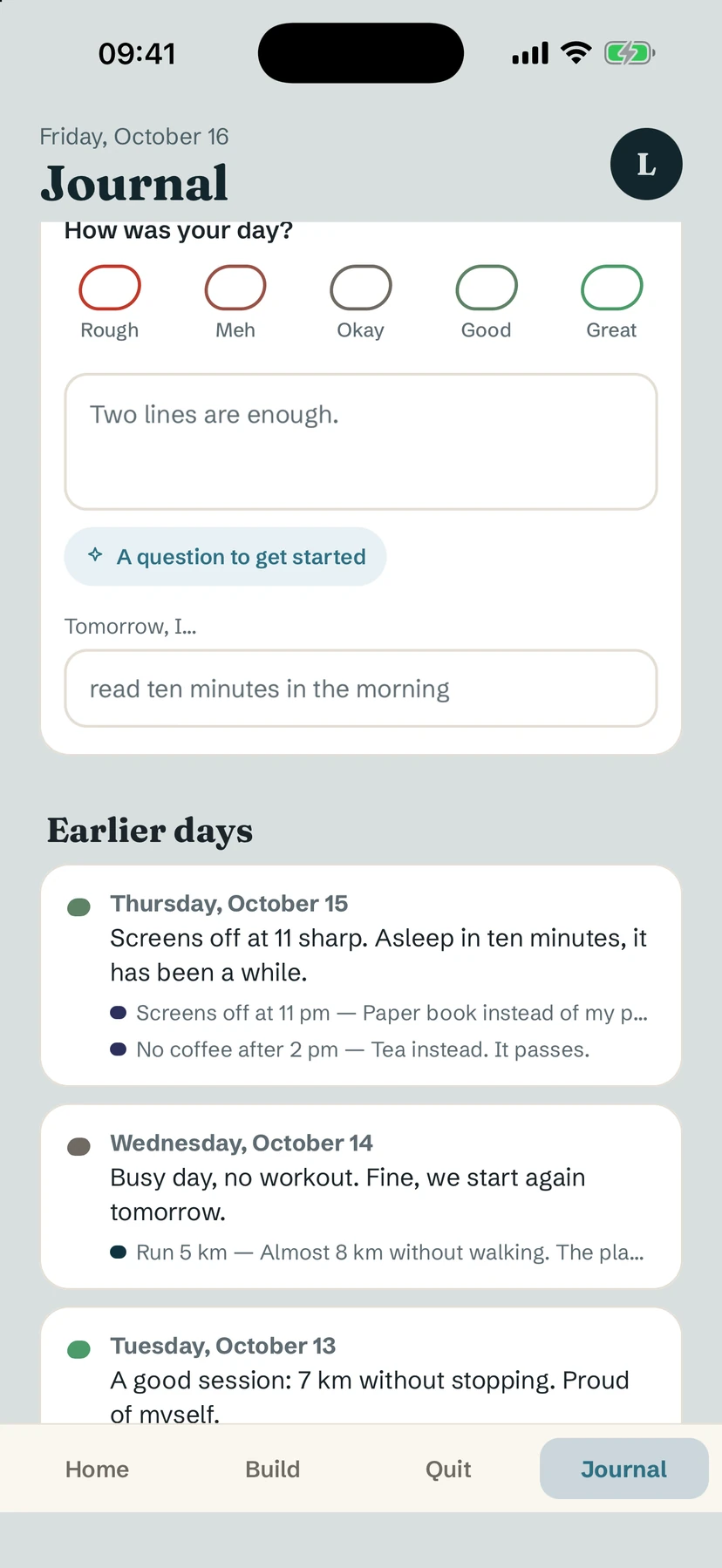
Yolmira's Journal tab is built on this template. You pick a mood — from rough to great — write a few words ("Two lines are enough"), and fill in Tomorrow, I…. The next morning, your intention comes back on the home screen: "Yesterday, you told yourself…". Stuck? A question to get started offers a prompt, and you can dictate instead of typing.
Under Your day, today's habits are listed with a note button for each, so your entry and your habits sit side by side. Earlier days shows a calm timeline of past entries. There's no streak and no counter of missed days, and everything you write stays on your phone. The journal is free.
Questions people ask
What should I write in an evening journal?
Keep it short: a mood, one or two lines about the day, one good thing and one small intention for tomorrow. Two lines are a complete entry.
Does journaling before bed help you sleep?
Research suggests it can, depending on what you write. In one sleep-lab study, people who wrote a to-do list for the coming days fell asleep faster than people who wrote about tasks they had already done.
How long should an evening journal entry be?
A couple of minutes is enough. A short entry you write every night is more useful than a long one you write once a month.
What are good journal prompts for beginners?
Simple ones: What went well today? What took more energy than expected? What's one thing that would make tomorrow good? Tomorrow, I…
Is it bad to skip days in a journal?
No. A journal has nothing to break. Skip when you need to and write the next evening.
Sources
- Frattaroli, J. (2006). Experimental disclosure and its moderators: A meta-analysis. Psychological Bulletin, 132(6), 823–865.
- Emmons, R. A., & McCullough, M. E. (2003). Counting blessings versus burdens: An experimental investigation of gratitude and subjective well-being in daily life. Journal of Personality and Social Psychology, 84(2), 377–389.
- Scullin, M. K., Krueger, M. L., Ballard, H. K., Pruett, N., & Bliwise, D. L. (2018). The effects of bedtime writing on difficulty falling asleep: A polysomnographic study comparing to-do lists and completed activity lists. Journal of Experimental Psychology: General, 147(1), 139–146.