- Choose one kind of journal and one moment of the day. Variety comes later.
- Set a minimum so small it always fits: one line counts as an entry.
- Research suggests writing about your experiences has a small but real benefit on average — and can feel worse before it feels better.
- After a gap, don't catch up. Write today's line and carry on.
Starting a journal is easy. Keeping one is the hard part. Most people buy a nice notebook, write three long pages, then miss a night, then a week, and the notebook ends up in a drawer. This guide is about the second part: how to choose a kind of journal that fits your life, make it a habit, and come back to it when you drop it.
What a journal can do (and what it can't)
Writing about your own life is one of the most studied self-help habits. In an early study by James Pennebaker and Sandra Beall, students wrote for fifteen minutes on four days in a row. Those who wrote about both the facts and their feelings around a difficult experience visited the campus health centre less often in the following months — even though writing left them more upset in the short term.
Since then, hundreds of studies have tested this kind of writing. A large meta-analysis by Joanne Frattaroli, pooling 146 experiments, found a positive effect on average, but a small one. And when people regularly wrote down things they were grateful for, in a study by Robert Emmons and Michael McCullough, they felt better about their lives than people who listed daily hassles.
So a journal is not therapy and not a miracle. It's a cheap, private way to notice what happens to you — and, used regularly, it seems to help a little. That's a good reason to keep it light.
Choose one kind of journal
"Journal" covers very different habits. Pick the one that matches why you want to write:
- The daily log. What happened today, in a line or two. The easiest to keep, and the most useful to reread months later.
- The evening review. A mood, how the day went, one plan for tomorrow. See our evening journal and its 30 questions.
- The gratitude journal. Three good things, however small. Good when your days feel heavy.
- The thinking journal. Longer, freer writing about a worry or a decision. Best used when you need it, not every day.
- The habit journal. A note next to each habit: how it went, what helped, what got in the way. Useful if you're working on a goal.
You can mix them later. At the start, one is enough.
Paper or app?
Paper is slower, which some people love, and it keeps you away from your phone at night. An app is always with you, lets you dictate on tired nights and makes rereading easy. Either works. Choose the one you'll actually have in hand at your writing moment, and keep it private: you only write honestly in a journal nobody else will read.
When to write, and how long
The best moment is one that already exists in your day. Right after brushing your teeth, in bed before switching off the light, with the first coffee, on the bus home. Anchoring a new habit to an old one is the idea behind habit stacking, and it works well for journaling.
Then set a minimum so small that it always fits: one line, or one word for your mood. Longer entries are welcome, but they're a bonus, never the bar. In the best-known study of habit formation, by Phillippa Lally and colleagues, simple daily actions took a median of 66 days to feel automatic, and missing a day now and then didn't stop the process. Small and regular beats long and rare.
When you don't know what to write
- Start with a fact: "Today I…".
- Name one thing that went well, and one that didn't.
- Write what's still on your mind right now.
- Finish with one small thing you'll do tomorrow.
For more ideas, our 30 evening journal questions are sorted by theme.
Coming back after a gap
Every journal has gaps. The trap is the backlog: you feel you should fill in the missing days before writing today's, so you write nothing. Don't catch up. Write today's line, maybe one sentence like "Two busy weeks, back now", and carry on. A journal has no streak to break. For the same idea applied to any habit, see what to do when you miss a day.
Read it back
Rereading is where a journal pays off. Once a week, take five minutes to skim the last seven entries. You'll start to see patterns: which days feel heavy, what lifts your mood, which worries came and went. Once a season, look further back. People are often surprised by how much changed, and how quickly the things that felt huge were forgotten.
When writing makes things heavier
Writing about something painful can make you feel worse for a while; that's what the early studies found too. If an entry keeps going round the same worry, stop describing it and write one small thing you can do. And if journaling keeps bringing up something hard, talk to someone — a friend, a doctor or a counsellor — rather than carrying it alone on paper.
A worked example: the first month
Week 1 — one line. In bed, before switching off the light: a mood and one sentence. Some nights, just "tired".
Week 2 — the first gap. Three nights skipped during a busy stretch. No backlog: "Busy week. Back." and the next line.
Week 3 — a little more. Most nights it's two or three lines now, plus one good thing. It takes about two minutes.
Week 4 — the first reread. On Sunday, five minutes with the month's entries. Two things stand out: the hard days were all days without a walk, and the good things were mostly about people. That's worth knowing.
Common mistakes
- Aiming for pages. Start with one line. Let length come on its own.
- Changing the format every week. Keep one kind of journal for a month before adding another.
- Writing for an audience. A journal is for you. Keep it private and drop the style.
- Catching up after a gap. The backlog is what kills journals. Write today and move on.
- Never rereading. Five minutes a week turns a pile of entries into something useful.
How Yolmira helps
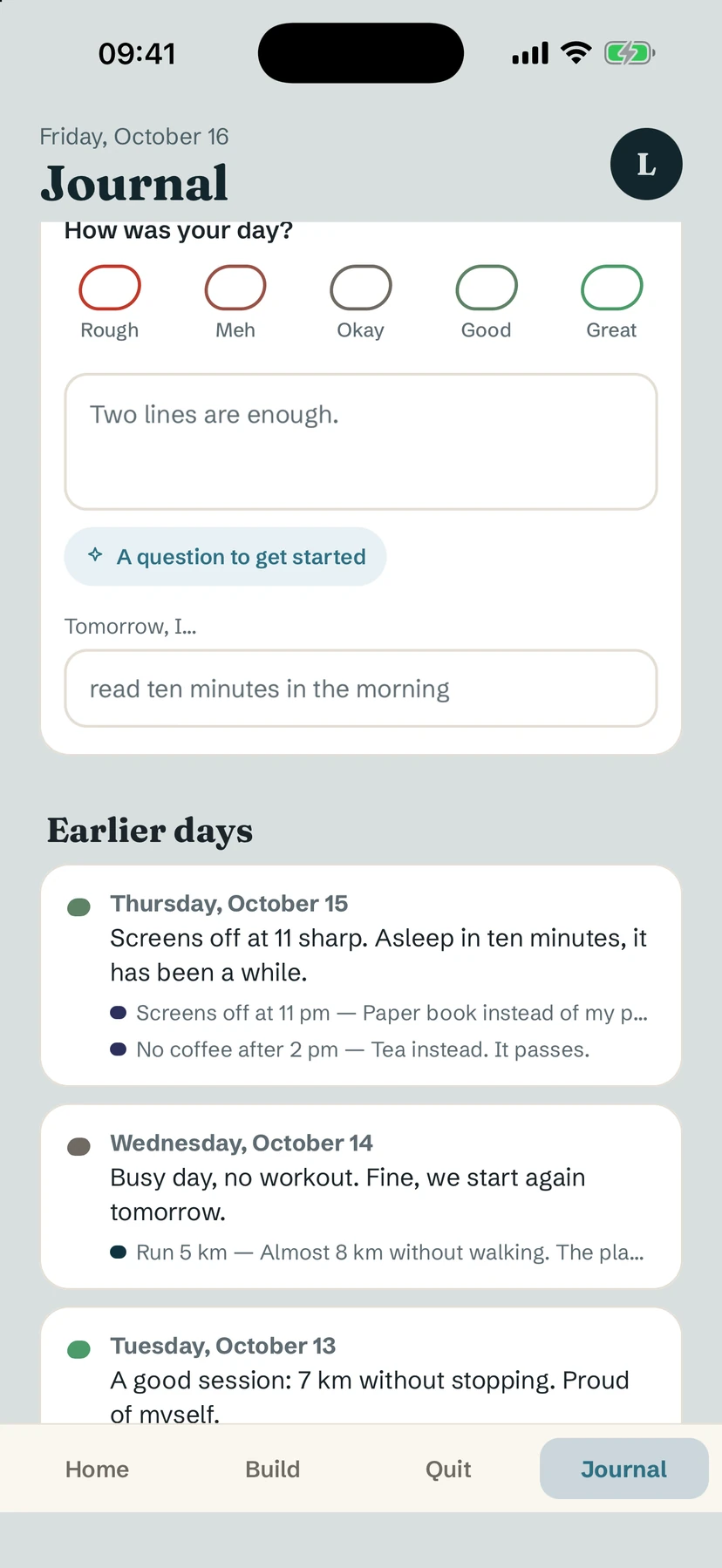
Yolmira's Journal tab is built for the small version. Pick a mood, write a few words ("Two lines are enough."), and add one intention under Tomorrow, I…. Stuck? A question to get started gives you a prompt, and you can dictate instead of typing.
If you're working on habits, you can also leave one short note per habit each day — see habit notes. They appear next to your entry, and Earlier days shows everything as a calm timeline, ready for your weekly reread. There's no streak and no counter of missed days, and everything you write stays on your phone. The journal is free.
Questions people ask
How do I start a journal?
Pick one kind of journal, one moment of the day you already have, and a tiny minimum such as one line. Start tonight, not on Monday.
How often should I write in a journal?
Daily works best if the minimum is small. A line every evening is more useful than a long entry once a month.
Is it better to journal on paper or in an app?
Both work. Choose the one you'll have in hand at your writing moment, and make sure it stays private.
What should I do if I stop journaling for weeks?
Don't fill in the missing days. Write today's entry, maybe noting that you're back, and carry on as normal.
Does journaling really help?
Research suggests it does a little, on average. Writing about your experiences has a small positive effect across many studies — enough to be worth a few minutes, not a cure for anything.
Sources
- Pennebaker, J. W., & Beall, S. K. (1986). Confronting a traumatic event: Toward an understanding of inhibition and disease. Journal of Abnormal Psychology, 95(3), 274–281.
- Frattaroli, J. (2006). Experimental disclosure and its moderators: A meta-analysis. Psychological Bulletin, 132(6), 823–865.
- Emmons, R. A., & McCullough, M. E. (2003). Counting blessings versus burdens: An experimental investigation of gratitude and subjective well-being in daily life. Journal of Personality and Social Psychology, 84(2), 377–389.
- Lally, P., van Jaarsveld, C. H. M., Potts, H. W. W., & Wardle, J. (2010). How are habits formed: Modelling habit formation in the real world. European Journal of Social Psychology, 40(6), 998–1009.