- Start with one evening habit, anchored to something you already do every night.
- A regular wake-up time, less caffeine late in the day and a dark, quiet bedroom are the best-supported basics.
- In a sleep-lab study, reading on a light-emitting tablet before bed delayed sleep compared with a printed book.
- Writing tomorrow's to-do list before bed helped people fall asleep faster than writing about what they had done.
Most advice about sleep is a list of fifteen rules. Most people try them all on a Monday and drop them all by Thursday. An evening routine works the other way round: a few small steps, always in the same order, that tell your body the day is ending. This guide gives you a simple template, the habits worth starting with, and what research suggests about each one.
What research suggests helps
"Sleep hygiene" is the name for the everyday habits around sleep. A review by Leslie Irish and colleagues looked at the evidence behind the usual advice — a regular schedule, less caffeine and alcohol late in the day, exercise, a quiet and dark bedroom. Most of these habits are linked to better sleep, but each one helps only modestly, and on its own sleep hygiene is not a treatment for insomnia. In other words: a few good habits, kept regularly, add up.
Screens deserve a special mention. In a small sleep-lab study by Anne-Marie Chang and colleagues, people who read on a light-emitting tablet for a few hours before bed took longer to fall asleep, released the sleep hormone melatonin later, and felt less alert the next morning than when they read a printed book.
And one finding is about the mind rather than the body. In a study by Michael Scullin and colleagues, people who spent five minutes before bed writing a to-do list for the next days fell asleep faster than those who wrote about tasks they had already finished. Putting tomorrow on paper seems to help you let go of it.
A 30-minute wind-down
Choose your bedtime by counting back from the time you need to wake up. Then, about thirty minutes before:
- Screens off, phone away. Plug your phone in to charge outside the bedroom, or at least out of reach.
- Close the day on paper. Two lines about today and one thing for tomorrow. Two minutes is enough.
- Prepare the morning. Clothes out, bag ready, the kettle filled. One less decision when you're tired.
- Something calm. A printed book, a shower, some gentle stretching, low light.
- Lights out at roughly the same time. Not to the minute — within half an hour most nights.
Earlier in the day, two background habits make the routine easier: a last coffee in the early afternoon, since caffeine stays in the body for hours, and a regular wake-up time, even after a short night.
Start with one habit, not five
The template above is the destination, not day one. Pick the step that would change your evenings most — for many people, screens off at a set time — and start with that alone. Anchor it to something you already do every night: after brushing my teeth, I plug my phone in the kitchen. When it feels automatic, add the next one. See habit stacking for more on anchoring.
15 small evening habits to choose from
- Phone on charge outside the bedroom
- Screens off at a set time
- No coffee after 2 pm
- A herbal tea instead of a last glass of wine
- Ten minutes of a printed book in bed
- Two lines in a journal
- Write one intention for tomorrow
- Lay out tomorrow's clothes
- Five minutes of tidying
- Dim the lights an hour before bed
- A warm shower
- Five minutes of gentle stretching
- A few slow breaths, lights off
- Bedroom window open for ten minutes
- Same wake-up alarm, weekdays and weekends
The phone problem
For most people, the hardest step is the phone. Scrolling in bed is designed to feel endless, and "five more minutes" rarely is. If that's your main obstacle, read our guide to stop scrolling in bed: it treats the phone as a habit to quit, with what to do when the urge comes.
Weekends and late nights
A routine doesn't have to be rigid. Late dinners and nights out will happen. Two things keep the damage small: keep your wake-up time within about an hour of the usual one, and on a late night, do the shortest version of the routine — phone away, lights out — rather than skipping it entirely.
Talking to a doctor
This guide is about habits, not medical advice. A routine helps ordinary bad nights; it doesn't replace a doctor's opinion. If your sleep worries you, talk to a doctor.
A worked example: the first two weeks
Days 1–4 — one habit. "Phone on charge in the kitchen after brushing teeth." Two evenings it's forgotten; the other two it works, and lights go out twenty minutes earlier.
Days 5–9 — the same, a bit steadier. A reminder at 10:30 pm helps. Reading a printed book replaces the scrolling.
Days 10–14 — a second habit. "No coffee after 2 pm" is added. Two lines in the journal close the evening, with one thing for tomorrow.
End of week two. Not perfect, but most evenings now follow the same three steps — and falling asleep feels a little easier.
Common mistakes
- Changing everything at once. One habit at a time; add the next when the first is easy.
- A routine that's too long. Thirty minutes is plenty. An hour-long ritual won't survive a busy week.
- Sleeping in to catch up. A very late wake-up on Sunday makes Sunday night harder.
- The phone "just for the alarm". Use a cheap alarm clock, or keep the phone out of reach.
- Turning bedtime into a battle. Some nights are just worse. Keep the routine anyway; one bad night doesn't undo it.
How Yolmira helps
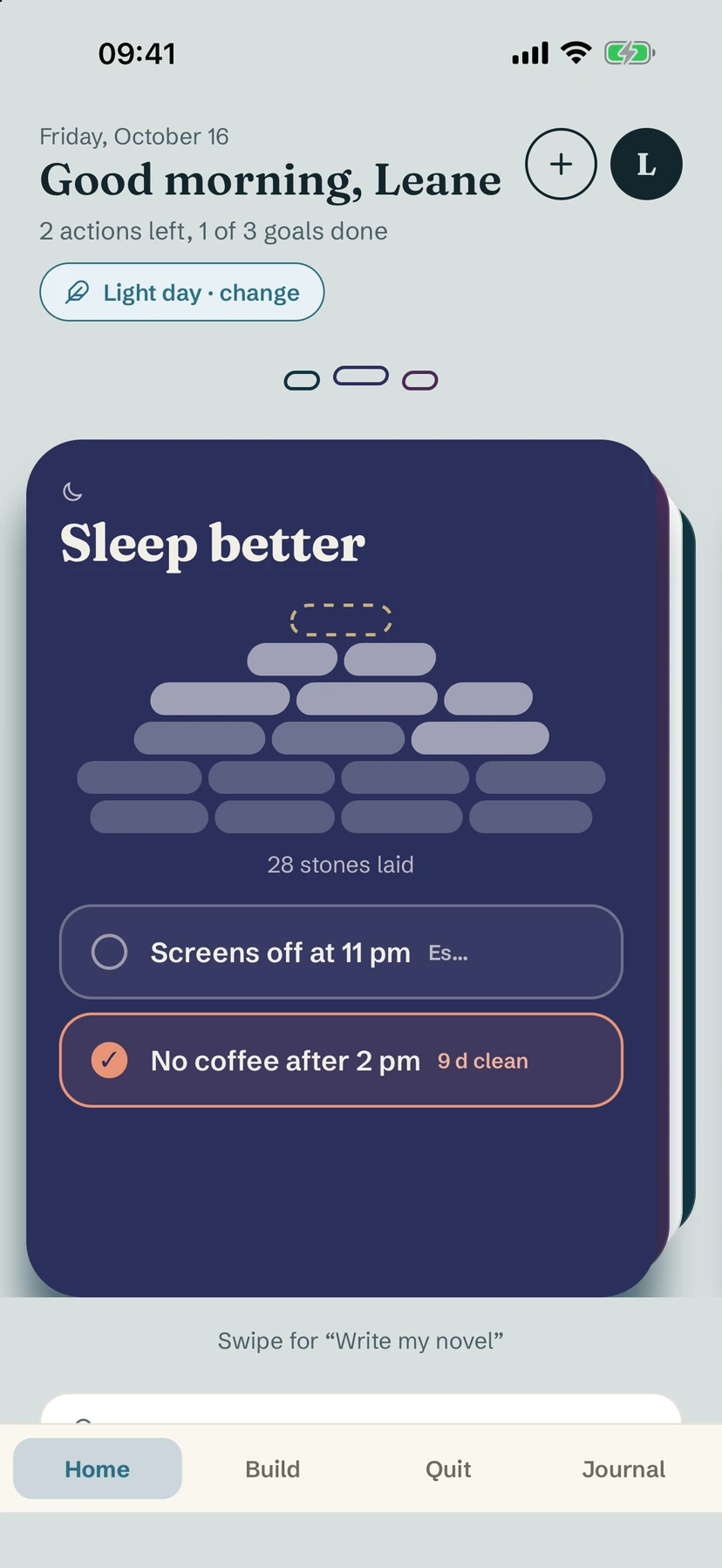
In Yolmira, create a goal for your sleep and attach your evening habits to it: one to build, like screens off at a set time, and one to quit, like coffee after 2 pm, which counts your days clean. Each habit can have its own reminder at the time you choose (+ Add a time), so the nudge arrives when the routine should start.
Mark your most important evening habit as Essential: on a busy day, Ease my day keeps only that one. And the Journal gives you the two lines and the Tomorrow, I… intention that close the day. Everything stays on your phone; building and quitting habits is free up to three habits.
Questions people ask
What is a good evening routine for sleep?
A short, repeatable wind-down: screens off and phone away about thirty minutes before bed, two lines to close the day, the morning prepared, something calm, and lights out at roughly the same time.
How long before bed should I stop using my phone?
There's no exact rule. Around thirty minutes to an hour is a practical target; the key is keeping the phone out of the bed, ideally charging in another room.
When should I stop drinking coffee?
Caffeine stays in the body for hours, so many people sleep better with a last coffee in the early afternoon. If you're sensitive, try stopping earlier.
How long does it take for an evening routine to become a habit?
In the best-known study of habit formation, simple daily actions took a median of 66 days to feel automatic. Start with one step; it gets easier well before that.
Can an evening routine replace seeing a doctor?
No. A routine helps ordinary bad nights, but it doesn't replace a doctor's opinion. If your sleep worries you, talk to a doctor.
Sources
- Irish, L. A., Kline, C. E., Gunn, H. E., Buysse, D. J., & Hall, M. H. (2015). The role of sleep hygiene in promoting public health: A review of empirical evidence. Sleep Medicine Reviews, 22, 23–36.
- Chang, A.-M., Aeschbach, D., Duffy, J. F., & Czeisler, C. A. (2015). Evening use of light-emitting eReaders negatively affects sleep, circadian timing, and next-morning alertness. Proceedings of the National Academy of Sciences, 112(4), 1232–1237.
- Scullin, M. K., Krueger, M. L., Ballard, H. K., Pruett, N., & Bliwise, D. L. (2018). The effects of bedtime writing on difficulty falling asleep: A polysomnographic study comparing to-do lists and completed activity lists. Journal of Experimental Psychology: General, 147(1), 139–146.
- Lally, P., van Jaarsveld, C. H. M., Potts, H. W. W., & Wardle, J. (2010). How are habits formed: Modelling habit formation in the real world. European Journal of Social Psychology, 40(6), 998–1009.