- Habits are triggered by context — a place, a time, a routine. Holidays change all three, which is why habits slip.
- Before you leave, pick one or two habits to keep in a tiny version, and pause the rest on purpose.
- A planned pause isn't a failure. What hurts is drifting and then deciding it's all lost.
- Plan the first day back before you leave: that's when habits really restart, or don't.
You leave for two weeks with every intention of running each morning and reading every night. By day three, the running shoes haven't left the suitcase. By the time you're home, the routine you spent months building feels like it belongs to someone else. This is normal — and it's predictable enough to plan for.
Why holidays break habits
Habits run on cues. Research on habits suggests that once a behaviour is linked to a place, a time and what comes before it, those cues start it more or less automatically. Your morning run is triggered by your alarm, your hallway, your usual route. On holiday, none of that exists: different bed, different hours, different people, different food. The habit isn't gone; its cues are.
That's why "I'll just keep going as usual" rarely works. Usual is exactly what's missing.
Before you leave: choose what stays
- Pick one or two habits that matter most. Usually the ones that make you feel like yourself, or the ones that are hardest to restart. Everything else can rest.
- Define a tiny version. Not "run 5 km" but "a 10-minute walk before breakfast". Not "read an hour" but "two pages before sleep". Small enough to do on the worst travel day.
- Pause the rest on purpose. Decide, before you go, that these habits are off until a given date. A decided pause feels completely different from a slow drift.
- Pack the cue. The book on top of the bag, trainers by the door of the hotel room, the water bottle you always use.
If-then plans for travel days
Holidays are full of unusual moments, and unusual moments are where plans written in advance help most:
If I wake up in a new place, then I go for a ten-minute walk before breakfast.
If I get into bed, then I read two pages, wherever the bed is.
If it's a travel day, then the habit is "done" with its tiny version — or it's a planned day off.
If I'm offered a second dessert I don't really want, then I say "not this time" and order a tea.
A change of scene can also be an opening
Disruption cuts both ways. In a field experiment, Bas Verplanken and Deborah Roy found that people who had recently moved house were more responsive to an intervention encouraging new everyday habits than people who hadn't moved. When old cues disappear, new routines have more room. A holiday can be a good moment to try something — a morning walk, no phone at dinner — that you'd like to bring home.
The first day back matters most
Most habits don't die on holiday. They die in the week after, when you're tired, the inbox is full and "I'll restart on Monday" becomes next month. Plan it before you leave:
- Pick the restart date — ideally the first full day at home, not "when things calm down".
- Restart with the tiny version, then go back to the full one after a few days.
- Don't try to catch up. Doubling your runs to make up for two weeks is how injuries and quitting happen.
Missing days doesn't erase what you built. In the best-known study on habit formation, missing a single opportunity didn't measurably affect the habit. A break is longer, but the same rule applies: what matters is getting back to it, not the gap. Our guide on missing a day goes further.
A worked example: two weeks away
Before leaving. Three habits: a morning run, reading, no phone in bed. On holiday: reading stays (two pages), the run becomes a ten-minute walk, "no phone in bed" pauses — it's the habit most tied to home.
Week one. Two pages most nights, a walk on four mornings out of seven. Two travel days are planned days off.
Week two. The walks become a habit of their own, by the sea. Worth keeping.
The first day back. A short run, two pages, phone in the hall. Full versions return by the end of the week.
Common mistakes
- Trying to keep everything. Ten habits on holiday means none of them get done, and a lot of guilt.
- All or nothing. If the full run doesn't fit, the walk still counts.
- Letting a pause become a stop. A pause has an end date. Write it down.
- Catching up on the way back. Restart small. You'll be back to normal faster.
- Judging the holiday by your habits. Rest is the point. A good holiday with fewer check-ins is still a good holiday.
How Yolmira helps
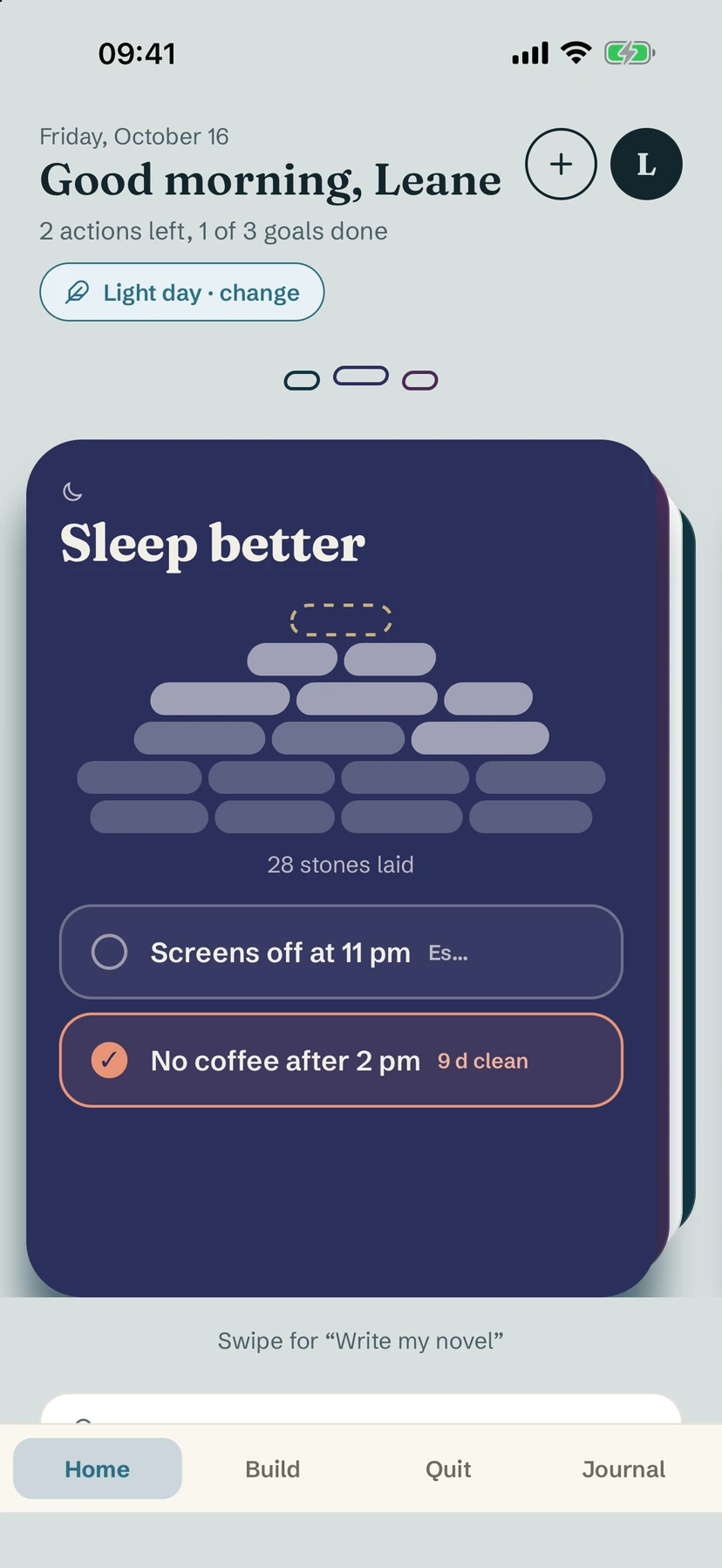
Yolmira was built for this. On the home screen, Ease my day lets you choose a light day: only the habits you marked essential are due, and the rest wait until tomorrow. For a real break, choose I'm taking time off and set the dates — up to 30 days. Reminders go quiet and come back the day after.
A light day or time off never breaks a streak, never takes a stone away and never counts as missed. Forgot to set it before leaving? You can ease a past day for up to seven days. Light days and time off are free, and everything stays on your phone.
Questions people ask
How do I keep my habits on holiday?
Choose one or two habits that matter most, keep a tiny version of them, and pause the rest on purpose until a set date. Plan your first day back before you leave.
Will a holiday ruin my habits?
Not if you plan the restart. Missing days doesn't erase what you built; what matters is getting back to the habit after the break instead of waiting for a perfect moment.
Should I take a break from my habits on holiday?
It's fine to pause some on purpose. A decided pause with an end date feels and works very differently from a slow drift.
How do I get back into habits after a holiday?
Pick a specific restart date, start with a small version for a few days, and don't try to catch up on what you missed.
Can a holiday help me start a new habit?
It can. Research on changes of context suggests people are more open to new routines when their usual cues disappear, so a holiday can be a good time to try something you want to keep.
Sources
- Wood, W., & Neal, D. T. (2007). A new look at habits and the habit–goal interface. Psychological Review, 114(4), 843–863.
- Verplanken, B., & Roy, D. (2016). Empowering interventions to promote sustainable lifestyles: Testing the habit discontinuity hypothesis in a field experiment. Journal of Environmental Psychology, 45, 127–134.
- Lally, P., van Jaarsveld, C. H. M., Potts, H. W. W., & Wardle, J. (2010). How are habits formed: Modelling habit formation in the real world. European Journal of Social Psychology, 40(6), 998–1009.