- A habit becomes automatic when it's repeated in the same context: the cue does the remembering for you.
- A good cue happens every day, is precise and comes right where the habit can start.
- Research suggests cues tied to events in your day build automaticity better than phone reminders alone.
- Put the new habit after an existing one, not before it.
"I'll meditate every day." When, exactly? Without an answer, the habit has to be remembered, chosen and started from scratch each day — and most days, something else wins. The fix is a cue: a specific moment that sets the habit off. This guide explains what makes a good cue, the five kinds you can choose from, and how to test yours.
Why the cue matters
Habits are, in large part, learned links between a situation and an action. In a review of the research, Wendy Wood and David Neal describe how repeating an action in the same context gradually lets the context itself trigger it, without much thought. Benjamin Gardner, Phillippa Lally and Jane Wardle turn this into simple advice: pick a cue, and repeat the same action in response to it, every time. The cue is what turns an effort into a reflex.
The order also seems to matter. In a small study by Gaby Judah and colleagues, people asked to floss right after brushing their teeth tended to build a stronger flossing habit than those asked to floss before — and they still flossed more eight months later. The existing habit worked best as a launch pad.
What makes a good cue
- It happens every day (or on every day you want the habit). "When I get home from work" fails on weekends.
- It's precise. "In the evening" is a period. "After I close my laptop" is a moment.
- It's in the right place. The cue should happen where the habit can start: stretching after getting out of bed, not after the commute.
- It comes before free time. A cue followed by an unavoidable rush won't hold.
- The habit fits the moment. Thirty seconds after brushing your teeth, ten minutes after dinner — not an hour after the alarm on a workday.
The five kinds of cues, with examples
1. A previous action — usually the strongest
- After I pour my morning coffee, I write three lines.
- After I brush my teeth at night, I plug my phone in the kitchen.
- After I close my laptop, I go for a ten-minute walk.
- After I sit down on the train, I read five pages.
2. A place
- When I reach my desk, I write down today's one priority.
- When I walk into the kitchen in the evening, I fill a glass of water.
- When I get into bed, I write one line in my journal.
3. A time — useful, but weaker on its own
- At 12:30, I step outside for ten minutes.
- On Sunday at 6 pm, I plan the week.
4. An event in your day
- When the kettle starts boiling, I do ten squats.
- When a meeting ends, I drink a glass of water.
- When I park the car, I take three slow breaths.
5. A feeling or an urge — for habits you want to change
- When I want to check my phone, I take one breath first.
- When I crave something sweet after dinner, I make a tea.
- When I feel stressed at my desk, I stand up and stretch.
For many more "after X, I do Y" combinations, see 25 habit-stacking examples.
Cues and reminders aren't the same thing
A phone notification is useful at the start, especially for things you'd otherwise forget. But research suggests it's a crutch, not a cue. In a study by Katarzyna Stawarz, Anna Cox and Ann Blandford, people who relied on reminders repeated their new habit more often, but it became less automatic than for people who tied it to an event in their day. The best of both: a reminder at the time of your cue for the first few weeks, then let the cue take over.
Test your cue for a week
For seven days, note simply whether the cue happened and whether you did the habit. If the cue didn't happen on some days, choose a more regular one. If it happened but you forgot, make it more visible — put the book on the coffee machine, the shoes by the door. If you remembered but didn't have time, move the habit to a calmer moment or make it smaller.
A worked example
The habit: five minutes of stretching. First cue: "in the morning". Done twice in a week.
Second try: "after my coffee". Better, but the coffee is drunk standing in a rush. Done four times.
Third try: "after I switch off the alarm, before leaving the bedroom", with the mat left on the floor. Done six days out of seven. The cue is precise, daily, and in the right place.
Common mistakes
- A period instead of a moment. "In the evening" isn't a cue. "After dinner, when I clear the table" is.
- A cue that doesn't happen every day. Choose one that exists on weekends too, or plan a weekend cue.
- Placing the new habit before the old one. "Before my shower" is easy to skip; "after my shower" carries momentum.
- Relying only on notifications. They help you remember, but a moment in your day builds the habit.
- Too many habits on one cue. One cue, one small habit. Chain the next once the first is automatic.
How Yolmira helps
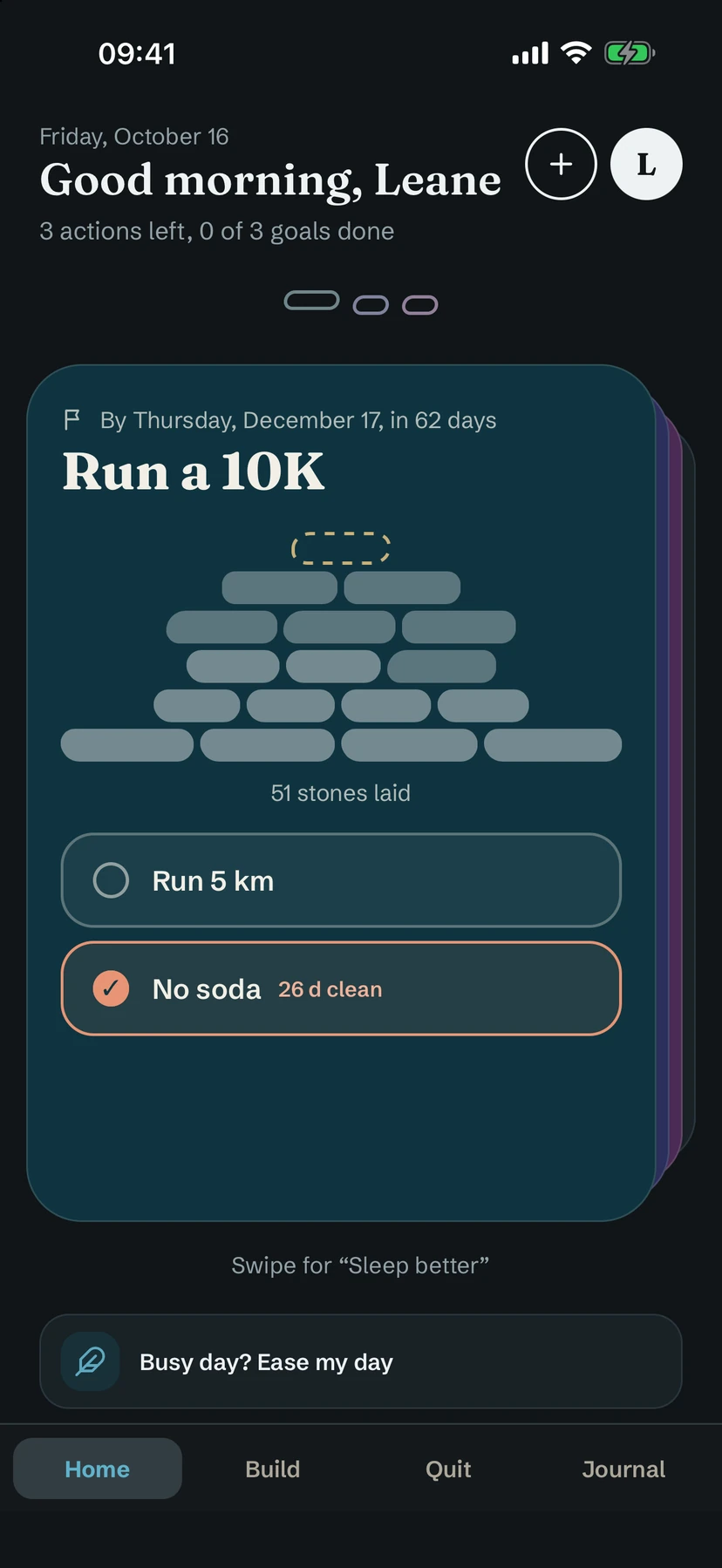
Yolmira is built around cues. In a habit's editor, the Anchor option ("After a habit?") ties a new habit to one you already do. When you check off the anchor, a quiet card appears: "You just did … And now?" — tap Done or Later. The cue arrives at exactly the right moment, without an alarm.
For the first weeks, you can also add a reminder at the time your cue usually happens (+ Add a time), then remove it once the habit runs on its own. Everything stays on your phone, and anchoring is free.
Questions people ask
What is a habit cue?
A cue is the moment that sets a habit off: a previous action, a place, a time, an event or a feeling. Repeating the habit after the same cue is what gradually makes it automatic.
What is the best type of cue for a new habit?
Usually an action you already do every day, like pouring your coffee or brushing your teeth. It's precise, regular and already part of your routine.
Are phone reminders good cues?
They help you remember at first, but research suggests habits tied to an event in your day become more automatic than habits that rely on reminders alone. Use reminders as training wheels.
Should a new habit come before or after the cue?
After. In a small flossing study, people who flossed after brushing tended to build a stronger habit than those who flossed before.
What if my cue doesn't happen every day?
Choose a more regular one, or give the habit two cues — one for weekdays, one for weekends.
Sources
- Wood, W., & Neal, D. T. (2007). A new look at habits and the habit–goal interface. Psychological Review, 114(4), 843–863.
- Gardner, B., Lally, P., & Wardle, J. (2012). Making health habitual: the psychology of ‘habit-formation’ and general practice. British Journal of General Practice, 62(605), 664–666.
- Judah, G., Gardner, B., & Aunger, R. (2013). Forming a flossing habit: An exploratory study of the psychological determinants of habit formation. British Journal of Health Psychology, 18(2), 338–353.
- Stawarz, K., Cox, A. L., & Blandford, A. (2015). Beyond self-tracking and reminders: Designing smartphone apps that support habit formation. Proceedings of CHI 2015, 2653–2662.